Showing posts with label philopsophy. Show all posts

Saturday, 7 July 2012

Sceptism

Melvyn Bragg and his guests discuss Scepticism, the idea that it may be impossible to know anything with complete certainty. Scepticism was first outlined by ancient Greek philosophers: Socrates is reported to have said that the only thing he knew for certain was that he knew nothing. Later, Scepticism was taught at the Academy founded by Plato, and learnt by students who included the Roman statesman Cicero. The central ideas of Scepticism were taken up by later philosophers and came to the fore during the Renaissance, when thinkers including Rene Descartes and Michel de Montaigne took up its challenge. A central plank of the philosophical system of David Hume, Scepticism had a powerful influence on the religious and scientific debates of the Enlightenment.

With:

Peter Millican
Professor of Philosophy at Hertford College, Oxford

Melissa Lane
Professor of Politics at Princeton University

Jill Kraye
Professor of the History of Renaissance Philosophy and Librarian at the Warburg Institute, University of London.

Producer: Thomas Morris

Denis Didarot - a thing is not prioved just because no one has ever questioned it.Something that has never been examined disppsionaltlye is not properly examined. Sceptisim is the first step towards truth
Sceptism - nothing can be known not even this.

Since the Renaissance sceptism has been important in learning.

Every day use of scepticism - someone who denies orthodox view. Someone who simply disagrees with the majority
Philosophy - more about doubt than negative asertion - questioning, investingating.
Sceptism about the exteranl world - induction  - is there a respns that the future will resemeble the past
Sceptiscims about moratlity

Not about 1 or 2 specific things - simply an attidtue of doubt towards everything

An over of the discussion - scepticism been around for a long time - in ancient world took a global form - globla form of life. By doubnting or undogmatic one could reach transquility
IN modern world it cast doubt on a lot of cntroversial things. Casting serious doubt that people were concerned about
People like Descartes and Hulme in conteporary world were a living forve because they were hard to challenge
Is there cetain knowledge? If taken seriously the scepticism shows that we can;t prove what we thought ee did
ie sciecen has a solid basis is difficult to prove.
Morality and religion - scetical worries are strong where there is real big differences of opinion
No one has good reason for what is being asserted.

Alive is the subject of scepticism

origins - in Greek the words means investigateion
A kind of midesty of what is known and a relativism
Socrates - what I do not know I do not think I know
I kow that I know nothing
True knowledge comes fromt eh limits of knwoledge

Around the world - moral and religious beliefs could simply be local applications of ideas.

Customs ad practices were a source of scepticism - from the way cultures dress being different to bigger issues.

Generalisation 5th centurey bc - thought was strongly associate with religion - the dogmas of
First big moves away from this was Spcatrtes and plato
Casting dounts on assertions - such a multi gods.
Used in a way to reatonalise not disprove

A release of thought? Freedom of thought association - expcially in later sceptics - is Siscero

3 types - the acamdemic and the pyrinist schols
traced to 30 century bc

Wise man knows the limits to his nowledge.
To have knowledge have to have a criterion of certainy - the academics challenged this saying we cannot have certain knowledge

pirinist school - readical - they held that we could be happy and tranquil without wisdom at all
suspend belief of any dogma - ie snow appears white but is it really - so suspend that judgement brings tranqulitiy

Certain knowledge - stoic claim - there has to be a crriterion - not just appearance is it really tyhe way it is in reality
We cannot have sucha  criterion - any appearance that ay seem certain is indistinguishable and we dont have this criterion

Piro - pionist school
3rd century - nothing written - legends and rumours only
anythign writtten was later in 6th century ad
Nothing was in itself good bad honourable or dishonourable - nothing was more this or that
he took this to such an extreme he would not pay any attention to anything around him
it walking by a cliff he wouldn't turn away fromt eh edge. friends kept him out of harms way.
He lived to 90
Piro was criticised for not paying more attention to his emotions or anything
Completely even demeanour
Stories he would continue talking even when someone walked away because that;'s what he was doing#
Tranquility of a pig eating - the wise man simply eats and ignores everything else

He suspended judgement in thought - but there are contradictions as to whether he really did live this way

Nieztche -

He stood for   cetrl idea - nothing is more this nor that - compltte inmdifference - leads to suspension of judgement - leads to peace of mind

Repelles - painter - painting the foam on the horse of a mouth - couldn't do it - in the end he threw a spionge and got the effect he wanted.
Hellenistic era

Plato - Sisero - from Platos school
He studied in Athens - with academic sceptics.
He writes about the philosophers ideas that were not previously written
Romans - very practical people but not very interested in philosophy
He wanted to bring philosophy to rome
He write about the epicureans
the stoics

Sexctus Empiricus - sceptic
he was anti scepticism
Important - because - 3rd and poss most important influence on works that survived to tell us about scepticism
collected all sorts of teaching of Pironist school
Outlines of Pironism

differeent arguments

a systematic collector of the different ways of arguing - the reasons for doubt
He emphasised the prolem of the criteriosn - wnat a criterion of truth but how do you know what's true.
circular problem
Accepted the philosophy of scepticism

The idea was to suspend judgement - codified a way of arguing from wither side - brings you a poistion of suspension so not arguing for against
Should not even assert that we cannot have knowedge

Augustine -?
engaes well with Sisero - a phase in his pilosophical and religious beliefs
didved the world into good and evil two forces battling it out
Maybe they are wiser to say doubt everythign and there was no certain knowledge - as per sisero
But in christian pahse argues against sisero
There are some necessary truths - I err so therefore I am - i must exist to make mistakes
preempting Descartes
I know that it feels cold - something I know
He also thinks there is a moral and religious danger to be sceptic
What about scepticism allowing immporality - others believed it would lead to paralysis but he thought it could be danger to immorality
ie it's ok to kill/murder

rediscovered in Renaissance - ;atin printing
Impact - sisero acedemico
more people reading it and copied being made
people writing commetnaries etc.
Sceptic is the translated word from Greek into latin -
Lage works -
Impericus - script circulating in 15th century
Greek a very unusual skill language to read -

Latin in 1560's - translated by a protestant - published
with the life of Piro and Laertius and Gaelen - the best method of teaching
attacking sceptcism

Sextist - wrote against everyone
he wante to show that for every argeument there is an equal force counter arguement
for every dogmatic arguement there is a valid counter - therefore suspend judgenmt as not finite answer

The context - invention of pringint - vast cicrulation  translated into latin
and also a period of doubt - population gowring - new world being discovered
suddenly aware that preioous teachings not syaing anythign about these other weorlds
so question confidence in the beliefs that have been advocated asserted
a starting point for doubt and questioning

Galileo - discoveries - aristotle views being over thrown

Descartes = seceptism as useful tool to get rid of orthodocy

Montagne (Michel)
accesed transaltion - impact on him
Essays written carved mottos from Impericus - suspend judgement I examine I don't lean this way more than that way
Logo - a pair of evely balanced scales - propositon and counter propisiotn

Important to him - brutal wars of religion in his time
People killin each other over things they beleived - result of dogmatism - does not allow us not to know what we do not know
It forces us to take sides.Scepticims can diffuse this

Schools - we don't know wnayhting - compatred with the search for certainty

Descartes - a tool for the search for certainty - scepticism a moment ot overcoe
monologue - single mind enquiring rather than opposing the outdi views
searching for the foundations of knowledge
Atrrovius - we are trying to build solid foundations
Quesyion all beliefs so can reconstruct foundational beliefs

I think therefore I am
Je pense donc je suis - changed to I think therefore I am

Contraversial - agenda for scince for decades to come
Attacked by religions - undermining the foundations of faith - he thoguht he was backing up the foundations but people wouldn't accept that idea

Empty sceptical influence - lots of followers
New physics

The theme got carried forward by Pierre Bayol - influenced by wars in Farnce 0 a french priotestatn - hugenot
Toleration - scetpcism - dialogue rather than sinlge minded - lots of views from all over the place - contrasts - all of them intending to promote tolerance and realisationt ehre is lots to be aid on all different sides.

Intertwined throught eh middle centuries and then on

Antiquity - sure up christianuty - leave s roo for faiht
also a danger as underines uncertatingty adn all beleifs

Nephew - gianferancesco - reader of books in greek
Attacks all vain doctrines but defeniding christianuty

a follower of sernorola
The vanity of pagan learning

Get reid of pagan learning then people will turn to the church - power
Montagine takes the view that Piro shoed the man without power and reason which encourages him to take his inspiration from on high
like a blank tablet on which the finger of God can carve whatever he wants

Hulme )(David)
influenced by Baiol
Issue that arguemtnes are presented - scepticism then makes room for faith
Fideous - beliees on faith but undermines human reasoning
Hulme - an atheist - 1711
greatest works - Treaties of human nature
mitigated works later on - academic scepticism - different understanding as to that of the ancients
make us aware of how little justifaction there is for dogmatisims
idea of enquiry

Modenr scientist as a view

prob of external world - grapples with this idea
belief in external world is incoherent - doesn't make sense to think an object lasts through time
Careless and inattention - won't pay any attention to the arguemtns
and the scetpcism disappears

Ultimate view - different - much calmer and relaced
extreme views - disappear
The whimsical condition of mankind - we can expect stones to fall or billiard balls to bash into the other when we hit them
We can not justify our own faculties
Cannot take everything down to basic pirnciples

Scietific enlightenment - really can't do sciscne with progress unless absolute certaintiy - infallible info
Another school fo thought - Frech - we cannot get that certainty ony God has that certainty but can get a second level of certainty - sfficient to get on with progress
Hob Thomas - political philosophy - not form somethign we know but from implication
buiold up political scinece but not on a claim of knowledge

We kow less that the domatists but more than the sceptics

We can have a certain knowledge on somet hings - getting thourhg by applying the idea of reasonable doubt
Doubt is not necessarily fromt he oppistite of beliefe but can be simply inquisitiveness and checking outthe basis of things
We don't always have to look for more than probabaility
More or less the principle of scince - best explanation of appearances

Scetpical chemist - we can go forward on linited certitude.

Sceptisims to day - epistomology 101 - how can we refute the sceptic - basic philosopy - how can we know what we know

actually odenr science is infused with scepticism.

Bliss
XX


Saturday, 30 June 2012

A world full of conformists

The question is "How can we know who we truly are in a world full of conformists?"

Fear based conformity. But actually when was this bred? And by whom? In my opinion this started way-way back in history in this society. How the Churches intially started to gain a sense of power I'm not sure. I imagine fairly early in our history. I imagine the less deeloped brain was bitten by the sense of power. Wehterh biologically less developed or intellectually or probably both. You see I am of the train of thoughts that we are ever evolvong. When you consider that the oldest part of our brain is similar to the of a crocodiles, it makes sense that our brains have been evolving which in turn provides more capacity for more complex cognition and mechanics, in turn giving us the need to develop areas of the brain more. Phenomenon that feed each other.
So in early days there would have been less cognition, less mindfulness and power would have been the way to overcome fears. So combined with some people gaining knowledge through experiences and finding ways of communicating that knowledge, they would have been given power and being the wise ones and in return they or someone would have been deeloping that sense of power without really understanding fully the implications. And so I see this as a way that power could have been evolving. Along this parallel would have been leadership from a point of bravery. Probably the stronger men who seemed to face fearsome beasts and invading tribes, cleverly leading and ambushing and thereby protecting his/their own tribes. So battling leadership alongside the leadership of principled people and presto the western ways were being borne.
And people will give their power to others who seem willing and better abled to protect and guide. The greater majority don't put their heads above the parapet. Thank goodness for those who do. But at a different prive to all. Thos that will deserve reward for the reward they give to the masses. Agreed. But when the imbalance of superiority takes over - hmmmm where is the balance.

And amongst the masses is bred a society of conformists. Is that how it started? Did the people conform naturally or did they give over their power and therefore have to start conforming. After all we are animals basically and therefore there is safety in grouping. To group or to belong there needs to be some conformity surely. We need to hold similar principles and be heading in similar directions otherwise we will have to separate. The start of individuals wo break away from society perhaps. Is this clever and to be admired or ridiculous and dangerous? We are all individuals withi groups.
How do we retain that sense of individuality within the group? In other words not conform so that we are so deeply entrenched that there is no original thought.

I received this message recently from the Universe ...

Bliss, please help spread the word. Here are the top 10 ways people give away their power:
1. Asking others what they should do.
2. Thinking God decides who gets what.
3. Worrying about how their dream will come true.
4. Thinking they have dues to pay.
5. Attaching to unimportant details and outcomes.
6. Believing in soul mates.
7. Thinking karma or spiritual contracts are absolute.
8. Fear of anything, especially falling in love.
9. Waiting for their ducks to line up before acting.
10. Choosing to be unhappy.

Understand the truth, little bird, and you will soar.
Caw-caw,
    The Universe


Interestingly, the first one, in my opinion, can be used in learning who we are. As a child we are guided and as a result start to learn about conforming within our family group. The rules of the family unit. Babies are culnerable and need basic nurturing to feed their hunger, quench their thirst, feel loved and safe. With these basics the baby starts to develop physically and psychologically. Furthermore, their physical growth enables the brain to start it's development. Many experiments suggest early stages of cognition, such as theory of mind and memory. Then as toddlers the child is learning about themselves from parents or guardians and maybe siblings. They are reflected back to themselves, often the centre of attention. And very demanding. But as time goes on they start to deperate, playing with peers and becoming slightly more independant. But still learning how to fit in and belong. So there is a degeree of conformity innate? And as I suspect is it that innateness escalated within the environment and interactions with people and situations. Which comes first innate or environment? I'm not sure they can be sepearated at all.
But as children we need to ask what to do to learn? Part of learning though is discovering what it is we need to ask about. Making mistakes and getting stuck is a part of the growth. The Vygotsky theory of having people to structure for us the parts we do not know the ZPD or Zone of proximal development and providing the scaffolding to make that transition from what is known and achieveable to the next step of what is just out of reach and on the way to the next bit of learning. A person who knows already and has experience can help the child cross that zone of knowing to the next stage.

But of course are we creating conformity in the scaffolding. This is one persons experience they are showing the child. But do many different scaffolders create confusion? Is it better to learn one way and then when comfortable in that way become open to many different ways.
I wonder for myself whether there was just such a fixed way. perhaps my brain could not cope with diversity. But now I'm more open. I refer for example to be open to creativity and art. As I have explored this and moved out of my comfort zone I've discovered how much I love and appreciate art. The more I get involved and view the more I am seeing and learning.

Unfortunately I have to end this thought process, this philosophincal discussion at this point. it would be interesting to get a creativists input into some of the science. Broaden my mind. It would be so nice if other people started to contribute. I am worried to invite people to read as they will access old thought patterns that have since shifted and old behaviours that I am ashamed of.
But hey this the whole me. The journey. Those people who are cited would be better off not reading as they will get into the inner thoughts that are loaded with my issues.  And indeed as I evolve those issues of mine alter and therefore my thinking through things alters too. I am way off target. So I'm justifying inc ase anyone I know reads.
I welcome a broader audience if it's there to be had because I welcome the opening of my mind with different ideas. I want to listen and share. Come on folks tune in. I think God will be helping this to happen if it's meant to.

Bliss
XX

OK I'm back and would like to continue with this idea a little more. It was strange really as a friend of mine is away on a weekend of philosophical discussions and what shoudl come up but who am I? And then on the radio I heard mention questions around conformity. My friend wrote to me "how to be free, can I ever be free in a society with others?" I find this both sad and interesting. This desparate need some of us seem to have to be different. And the arrogance of this too. There is surely a way to find the balance of being and individual within our cosiety and community. Whatever we do we end up being with like-minded people. And if there is this drive to be absolutely individualistic then life would become like a hermits life. Keeping away from people for the fear of being the same as them. I wonder what reasons people who live as hermits live that way. Are they leaving society for this reason, or because they just can't seem to find like-minded people, or it's too difficult to wor through the difficulties that can arise in the interactions with people or simply not liking the society within which they live, such as the rat race or the waste and over consumption, or the ethics and morals. I suspect there are more people living a solitary life even if appearing to be within the community.

It's a self imprisonment though. Being humans, or rather animal, there is an instinct to have both community and companionship and that means also finding similarities. This drive to be different and stand alone is something else. Is it once again driven by experiences from the past? There is surely a balance between maintaining one's own identity, personality and ideas whilst also being able to be a part of and open to others contributions. The celebration of similarities as well as differences.

Monday, 25 June 2012

Who am I?

An article taken from this Blog - http://blog.melschwartz.com/2010/06/03/who-am-i/?goback=%2Egmr_2316564%2Egde_2316564_member_126718945

Who Am I?

This question — asked so often — suggests that there is actually a plausible answer. Almost as if our being were a fixed thing. People who ask this sort of question are typically struggling with their identity and are searching for a core sense of themselves. The irony is that the more you seek to identify who you are, the more fragile you are likely to feel about yourself. There may be an inverse correlation between the question being asked and the ease with which you experience your life. The emphasis shouldn’t be on discovering who you are (what is buried beneath) but on facilitating the emergence of what you’d like to experience.
Our identity should be seen as an ongoing process. Rather than a static snapshot, we should embrace a flowing sense of self, whereby we are perpetually re-framing, re-organizing, re-thinking and re-considering ourselves. How different would life be if rather than asking who am I, we contemplated how we’d like to engage life?
A sense of inadequacy often informs the question around “who am I?” As people engage the deepening complexity of understanding themselves, they would fare much better to devote themselves to the unfolding process of life. Witnessing our thoughts, not reacting out of old habit, and becoming present enable us to better craft our lives. As such, the identity that we seek fires the wave of life, enriched by the flow.
Imagine that you’ve been in prison for twenty years, incarcerated since the age of eighteen. You literally have no adult life experience outside of the penitentiary. Your sense of self is tragically limited. You might ask yourself, “Who am I? This would likely provoke a fragile sense of self that paradoxically might leave you most apprehensive about your imminent release. You’d hardly choose to remain imprisoned until you could find your identity. You’d have to permit that new sense of self to flow from your new experiences.
I have worked with people who have been married more or less for their entire adult lives. Upon divorce they are often confronted with a distressing thought. They claim that they don’t know who they are. More to the point, they may not know who they are as a single, autonomous adult, not partnered. After all, how could they? Rather than remaining mired in fear, you’d need to summon up a sense of wonder and adventure. There is a new sense of self waiting to be born. You get to re-craft yourself along the way.
At the other end of the identity continuum are those who claim to know themselves so well. This other extreme also signifies a fragility about one’s identity. To know yourself so well, leaves no room for growth. Even more, it suggests a deep vulnerability that is being defended against — as if it were too dangerous to take a closer look.
It makes perfect sense to seek a deeper sense of self. To become intimately aware of your thoughts, feelings, hopes and fears is obviously advisable. The key is to engage your sense of self as malleable, more like a willow tree than a sturdy oak. The willow is flexible and survives the storm as it bends with the wind, whereas the more rigid oak is more likely to crack.
The universe purportedly exists in a state of flowing potential. And it is essential to understand that we are indeed part of that universe. The goal then is to access that potential, keeping the parts of our identity that continue to serve us well and shedding the old, habitual pieces that constrain us. This process is known as positive disintegration. This permits us to find balance between the extremes previously discussed and enter into a relationship with self that commits to our personal evolution.

And some of my ow meandering throughts ...
I thought this was a well considered opinion of the concept of learning about self.


I agreed with the idea of the willow tree. Getting to understand myself in the varied situations life brings is important I believe. Forever taking steps to bring to my consciousness my motives, my emotions, my thoughts, my beliefs and questioning those too. Being curious for the purpose of obtaining THE knowledge reminds me of the oak tree referred to. It's too rigid, no flexibility, no give, no humanness. Curiosity though can be wonder and awe. Curiosity killed the cat they say, but curiosity can also be a useful contributor in creating awareness and providing newness and adaptability. Taking a moment to assess my inquisitive agenda is a useful tool.
Then I begin to see who I am rather than s who I am.
I also like the suggestion that who I am is informed by who I've been. This can be limiting in itself and so the positive thinking about every new experience being and adventure and an opportunity can relieve me from the constant fear I live in. Yet I have the desire for adventure and new experiences. There is a big wide world out there but there is a bigger world inside that often goes unexplored. For every situation wouldn' it be fun and interesting to take a look inside and experience both simultaneously. I have thrilling moments of self awareness. A real sense of "oh, that's why", when I really sense the something inside coordinating with the something outside.

And the idea that who I am is ever shifting according to the current environment. But to know that my perception is influenced from experiences from the past. And each of those experiences has been guided by my perspectives from before that and so on. I truly believe that my sense of the world, everything and everyone in it starts at conception. Sameroff's Transactional Analysis applies from that very moment. He attempts to present a simple model of the complexity of being a being on this complex and delicate interconnections of this planet. How awesome is that? I get an acceptation of the magnitude of the Universe. Al the energies flowing and complimenting or contrasting or conflicting. When I can go with the flow of that i realise I don't need to understand, it just is and I am simply a part of "it" all. The problem arises when I am afraid and want to know absolutely. When I want certainty. When I am desiring to know then there is likely to be fear. I can take a look at the fear the more conscious I become. And then I have the chance to go through the fear. I can accept it as a part of who I am. Like the prisoner stepping out of prison for the first time in 25 years. It must be a terrifying experience. I suppress that fear for the fear of being vulnerable and being taken advantage of. That's my experience somehow of being vulnerable. I can look back and see how situations thought my childhood development have contributed to that perception that the unknown is frightening. Equally I can see the influence on my need to cover up vulnerability. And that is no ones, absolutely no one, fault. Each of us throughout the generations are simpy trying to do our best but we are defective and that's that. I have some understanding of why my dad behaved in the way he did and still does. He has to cover his vulnerability. When I've stopped to listen to his stories of his own past, his experiences taught him to find coping strategies that were probably taught to him and taught from the previous generation and the generation before that and so on. The lessons get distorted and contorted and adapted to the current social influences no doubt. The end result is in my behaviours, attitudes, beliefs, thoughts, and emotions today. What I can do is sift out what is actually not working anymore and with help learn new ways of being that are more conducive to who I want to be.
And this is where I like the idea in the Blog that as I become more conscious I am better able to choose who I would like to be and explore within the situation how I can achieve that.
Just some ideas from the armchair, theory is great but action is the evidence of knowledge, that I thought I'd share with you. I would be very interested to know what your interpretation of this might be if you feel so inclined to share them with me.

Bliss
XX

Passion brings life struggles and thereby emotions

Our job is to monitor our emotions and continue to operate with good grace. Another choice is to desensitise and remove from struggles through addiction, through isolation, through emotional detachment, etc but with it goes any passion. These things are intrinsically linked. I want to feel passion. It brings also with it invigoration and energy, motivation to do more, experience and absorb more. All I need to do is learn acceptance and ways through the emotions as they arise. If I keep my faith then trust will carry me through any situation and any emotional response. So long as I monitor my response to my feelings. Out with reaction and in with awareness of behaviours, attitude, beliefs, motives, thinking and opinions.

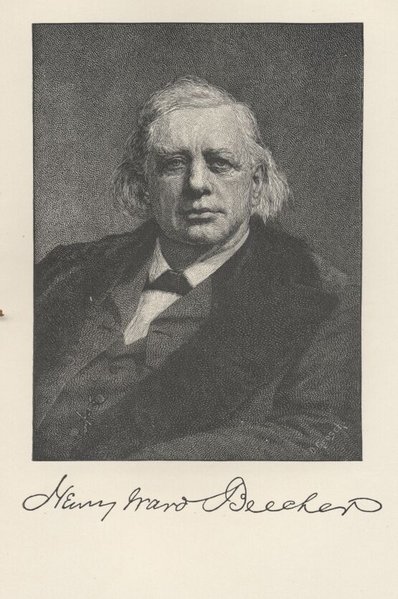
File:Henry Ward Beecher - Project Gutenberg eText 15394.jpg

Henry Ward Beecher said "No emotion, no more than a wave, can long retain it's own individual form". Quoted at the beginning of the film The Air That I Breathe by . This film was given just 2 stars by Empire. Interesting. It does seem a little cartoony but I've only just started watching it. Let's see what unfolds before making a decision. Having seen that though I am immediately influenced, so uncertain of my own judgements and wanting to appear intellectual and insightful rather than influenced by dross and lack of taste. Ha! This is funny having watched Grayson Perry's 3 part series on taste through the classes. I realised that the lower class have the most fun, wanting to be part of and samey but pretty relaxed about it and not trying to impress. It matters to me what I lie and don't like because of what other people will know about me. I think they'll see my lack of a creative mind and uneducated. Blimey! How did I ever get to be so shallow?
Until seeing that quote at the start of the film The Air That I Breathe, I had not heard of Henry. So reading his story was interesting. And even more interesting that despite being the centre of a highly publicised court case for adultery, there is no film produced about him. His life sounds worthy of more public awareness. He was heavily involved in abolitionism and a supporter for the women's suffragettes of the mid-1800's in America. A man one would think worthy of his story being told including the salubrious affair. A theologian, he advocated that sin was a temporary state of being for man and mankind, "which the love of God could burn away as a fierce noonday sun dries up a noxious mold," (Wikipedia).
So turning towards God means being loving from the heart. And then aware of my heart any sin is something I would (and do) want to address. I want to be closer with God's love for everyone and everything. This requires me being rigorously honest. Which I am not always but doing my best to correct this.
When I claim dishonesty, it could be something that on the surface appears slight and forgivable. As an example to some it may be quite acceptable to say I feel fine when in fact I am really in pain through trying to suppress specific feelings. This truly comes into action when I am particularly afraid of a person. I am unlikely to express my fear. The fear of being vulnerable stops that. For example being afraid that M will withdraw her friendship, but then to be vulnerable about that with her seems to me to be inappropriate. But instead of talking about this with others, I struggle away with it, acting out in less than honest ways. For example I was not saying when I was meeting up with other people that she knows as well. Without knowing why I felt afraid that if I did she would become upset with the situation, put the blame on me and then withdraw from me. And indeed speaking earlier today she owned how she can feel jealous and abandoned and her response is to withdraw in various ways. She described it as a childish response. It was good to hear that. I was able to speak about my apparent secrecy. I recognise now that there are many times and things I share with no one. Not out of a knowing need to deceive or keep secrets. Consciously there seems to be no need to tell anyone. My mum used to say I appear to simply take everything in my stride. I get on with things. Without passion perhaps or without showing anything at all. Because if I did then what? Would it be because I would be questioned or told not to and I want to. Perhaps it's because I don;t think anyone would be particularly interested or care? Often it just does not seem to occur to me to tell people what I'm doing or thinking. I just do things. For example. People don't know I write a Blog. Some of it I wouldn't them to read as there are inner thoughts that are part of processing and not the full and final result. People would be offended if they knew all my workings out I feel sure. Then there are things that I've done that I feel ashamed of. However, these things are the truth of me. I am imperfect and my processing is often flawed. Especially when I keep it private. I can be convincing. That's why it's better to talk things through and get others opinions or individuals meanings and intentions clarified. So I am interested in why I don't tell people things. By talking about this during the morning with K she suggested I sit back with God and thank Him for helping me to open and free with other people. "Thank you God for helping me with this" I believe this is for a good cause including feeling better with myself but also to show to others that I trust them. I think this will also show that I value them. Would it? It might help M to trust me more and I would feel better that I'm showing her how much I value her. Thank God for the creation of this awareness. I think it's probably just the start of it but it's giving me something to think about and now I need Your help to make changes.
It was lovely speaking with K this morning as well and hearing how she is praying for God to help to find compassion. This links strongly with my hope that can listen more to people. Thank you God for showing me how to have compassion and to be able to listen to people. If I can observe how things unfold then I think I step back from the emotion and that then doesn't drive the next best thing I do. If I observe I create more time to invite God into the situation or interaction. If I observe then there is time to ask God if my action is necessary, appropriate and truthful. Slowly, slowly improving.

Well Southampton are honouring my leave and study days. They have not confirmed whether I could claim a fixed monthly amount for the petrol. They are offering either OT or a change in times when the other person is away. She will check about additional 1:1's which are paid at £40 per hour rather than £35. I just can't decide whether the extra travel is worth it or not. 8am until 5pm 3 days a week and 8am until 9pm every Tuesday. God please show me what is the best thing to do here. I am off sick today so perhaps I can sit back in some quiet time and contemplate this.
If the EHDC housed me in Grayshott this would help. I have submitted the forms and trusting that being employed and earning won't affect my rent and security here but that they will also consider me favourably to relocate closer to Arford. That's what I'd like but I trust God has in store for me what is best. I do not go with the Calvinist belief, at least I think I've briefly understood this correctly, that Calvinists believe that our paths are predestined by God. I don't know why but it just seems too convenient. It does mind circles with me. Because I think that choices take us into different directions. If my relationship at home would have been different then perhaps depression and addiction would never have been triggered. However, there is a degree of predisposition within genetics. For example I do believe that the gene is there but will not necessarily be triggered. Circumstances will cue the sequence of events that will result in addiction for example. And then there is the environmental influences, such as Nixon's need for votes from the farmers and housewives contributing to fence to fence farming, resulting in a surplus of corn waste that two Japanese scientists used in the production of corn syrup, contributing to increased processed foods and resulting in addiction and obesity. Then the greed for power food industry capitalising on this and being a contributory factor in my own food addiction to sugar, flour and quantity. Nothing stands alone. It's all so very complex but also so very obvious. Interconnections that only Universal Energy can have an overview on but surely not a destiny already written?
K was talking about compassion explained through her Priest. She recounted her understanding from the Priests use of the parable about the Good Samaritan. The Priest said that Jesus uses this parable to illustrate eternal life which is what a lawyer questioned of him. K sees eternal life as serenity and peace within. Interesting as eternal life means to me the legacy that I leave behind even if it it isn't a direct quote or reference to me. The legacy I wish to leave behind is serenity and grace which means I need to work towards it myself before it can be passed on in any shape or form. Not find it but be working towards it.

The Good Samaritan by William Hogarth
According to the Priest Jesus said there are just two things the lawyer needed to do to be assured of eternal life. 1 - the love of God and 2 - the love of thy neighbour. But what does loving thy neighbour actually mean? It means to have compassion. Which interestingly is a part of what the Dalai Lama was saying. To have mutual respect for each others differences, cultural, social, beliefs, physical, spiritual or religious, educational, environmental and emotional. There could probably be more. The Dalai Lama was also saying this means to have compassion for the different struggles and how these manifest through people. Struggles as we know are a sign of passion and as I suggest passion will emerge as energy through emotions and actions. Communicating openly and honestly through listening and observing will serve us/me well. So the Priest went on to explain the story of the Good Samaritan. Firstly a Priest passed by the man in need. But he was on his way to a important destination. He had spent a week being cleansed in preparation for this place he was heading. To stop and help would mean taking him off schedule and inconvenience him because he would have to return to the starting point to be cleansed. Yes he would be too greatly inconvenienced to be able to stop and help. The second person passing was by was following the Priests lead. If this Holy man, a Priest could not delay his journey to help then helping was of less importance. So the second man did not help the man in need. However the third man, who was completely out of his home environment, went out of his way to help. He had compassion for this man in need despite the great cost to himself of time and money. He felt compassion in his heart and it was this that more than anything else made him want to help. I will add here that I think there is caveat to ensure that help given is actually the help wanted and needed. I think there are a lot of people who might impose their idea of help upon others. It's a form of conceit and power I think.
The thing is and as K said there are things that I really couldn't care less about. I am not really worried about such as uhhmmmmm well uhmmmm I would say world conservation t the level that I really take action. Or the plight of the film industry with piracy via the Internet escalating and seemingly beyond control. I'm aware but do I care? Not really fully but sort of. The thing is I want to care about things, people, places. This is where passion is, this is where emotions can be found. If I am not compassionate there is room for behaviours to be guided by emotions such as jealousy and fear and anger. God please help me to change my heart. SH used to say don't care was meant to care. I don't truly understand the sentence but I understand the meaning. When I don't care about something perhaps I need to take another look and find out what is really going on. I recall being in group and listening to a lady whose son had been killed in a tragic accident. Furthermore, her husband was disappearing from her with Alzheimer's. She had been so in love with this man but now she was having to watch him disappear and yet still be there. Not having had these experiences but having experienced the death of my mum I thought that I knew the experience. It was someone else who said I cannot imagine how this must be for you. I observed how this lady suddenly felt heard and understood. There was a release of emotion from her and a sudden warmth from her that at last someone cared enough to hear what it was like for her and stop telling how she needed to be. This was a lesson but not lesson enough. Please God help me to listen with respect, trying to understand what it's like for the person. Please give me the questions to ask that helps them to express so that I can understand better and they can have faith in my care - friends, family, clients, colleagues, passers-by. Please help me to have compassion and to be able to support them however seems appropriate, finding the balance between meeting their needs and not enabling their wants. Please help me to show their value from my love for them. And this way show me how to be gracious and contribute to peace. Thank you God.
Thank you God for the last call I received from S. Amazing how she actually used examples from her FA experiences to exemplify not being heard and feeling really respected and listened to. of course she had her part when a few years ago in FA she was stating her case for Ramadan. Her awareness each year has grown and she could see today how she was manipulating for the sake of the food by saying that the large feasts in the evenings were all a part of the culture but now she is seeing how she was eating differently from others. She would binge and feast whilst she sees recently that people take their plate and then wrap food up to use throughout the week. I asked her the significance of Ramadan. S explained that it was recognised within her faith that food is something that takes one away from their conscience and so this period of fasting over a month is a time to remove the obsession and indeed any other habitual behaviours such as smoking to make the room for more mindfulness and meditation. It is also a time to remember people who don't have as much or anything at all. Everyone has something even if it's inner something but I guess you'll know what I mean. I'm sure there is more to know but this was it in a nutshell. How interesting that recognition of food being the focus and the time made to remove it and change the focus. And also how striking that she should be calling to say how she felt really delighted with the response of her current sponsor. In the past she was met in her opinion with rigidity and no room for supporting her religious practises. I asked how it was different and how she felt respected and listened to. She said this sponsor asked her questions and thanked S for being so informative and helping the sponsor to understand better this time. The suggestion has been to take some quiet time. Her sponsor will talk to her sponsor and there is experience already within the rooms when people are practising the Jewish faith and Yom Kippor. There is always a solution it doesn't have to be a no! This was another level of interest for me. I am recognising a rigidity in the lineage I am with. There is no room for manoeuvre. At this time it suits me well. I know it's working and to be honest I haven't asked too many questions of it. I was surprised that I could have basil leaves within my salad and delighted to be able to too. But things like exotic fruits. Who says they are exotic? I have been fortunate enough to have worldwide fruits since a child because my mum brought them back from her travels. Now all sorts of fruits are easily accessible from supermarkets. Does this make them exotic because they are not grown here. But an apple might be exotic in another climate. Anyway it is a little niggle in the back of my mind so this was enlightening. There is recovery to be had within any situation.
Now I was really pleased to be able to speak with S and ask her questions so that I understood. I also listened to her talk about her course in which she has realised that she and her boyfriend need to talk about their long term plans and see the familiar grounds and understand where they are heading as individuals and together. I liked this. She is on a management course. I wonder how often we all sit and consider our short, mid and long term plans.
I quite easily sit here just trudging along with great ideals but  no real sense of what I want to be doing in a years time or 2 or 5 years time. I am aware that there is a short life span amongst the females in my mums family so it would be a good idea to put some focus into this - mindfulness.
So many subjects covered today just through talking and time to consider them.
And all so very connected. Mutual respect, compassion, love and peace. IN that order it seems to me as well
Thank God for bringing these messages to me to consider and thank you for helping me to put these into action.

Bliss
XX


Sunday, 24 June 2012

The Myth of Sisyphus

He is not poor in health who is great in soul - Albert Camus

What did I notice about me today. Well in comparison with yesterday I was feeling much more comfortable doing my style of therapy. Yesterday and even this morning I was wondering what I thought I was doing?? What the hell do I know? How can I sit and be a therapist? People come along, they talk about the things they want to talk about, I summarise and paraphrase and at times question or suggest. T for example wants to reject every idea and yet comes to me to ask if he can do this or do that? I asked him about asking permission. He didn't own it, he side-tracked it completely. He is certainly not very present or aware of the here and now. He doesn't want to go anywhere near emotions apart from as an intellectual exercise.
I wonder if he would be an ideal candidate for day care with PD. I will pose the question to him.
Oh well anyway, you know the kind of thing.
I went to therapy to get someone else to sort out my life. But that isn't really what happened. I got more information about myself. I got some understanding. That's what helped me to sort out y own life - well to some degree. It's not sorted, it's unravelling. And will be until death to us part - me from life. But the support helps me to manage on a daily basis. I remove addictive behaviours an then I'm left with the feelings and then what. Just get on with it. But sometimes I can't just anything. What on earth is it all about. It's absurdism. Trying to make sense of things that have no sense. Trying to find purpose but never finding it, always looking for it.

Sisyphus by Titian (1490-1576)

File:Punishment sisyph.jpg

The Myth of Sisyphus

by Albert Camus The gods had condemned Sisyphus to ceaselessly rolling a rock to the top of a mountain, whence the stone would fall back of its own weight. They had thought with some reason that there is no more dreadful punishment than futile and hopeless labour.
If one believes Homer, Sisyphus was the wisest and most prudent of mortals. According to another tradition, however, he was disposed to practice the profession of highwayman. I see no contradiction in this. Opinions differ as to the reasons why he became the futile labourer of the underworld. To begin with, he is accused of a certain levity in regard to the gods. He stole their secrets. Egina, the daughter of Esopus, was carried off by Jupiter. The father was shocked by that disappearance and complained to Sisyphus. He, who knew of the abduction, offered to tell about it on condition that Esopus would give water to the citadel of Corinth. To the celestial thunderbolts he preferred the benediction of water. He was punished for this in the underworld. Homer tells us also that Sisyphus had put Death in chains. Pluto could not endure the sight of his deserted, silent empire. He dispatched the god of war, who liberated Death from the hands of her conqueror.
It is said that Sisyphus, being near to death, rashly wanted to test his wife's love. He ordered her to cast his unburied body into the middle of the public square. Sisyphus woke up in the underworld. And there, annoyed by an obedience so contrary to human love, he obtained from Pluto permission to return to earth in order to chastise his wife. But when he had seen again the face of this world, enjoyed water and sun, warm stones and the sea, he no longer wanted to go back to the infernal darkness. Recalls, signs of anger, warnings were of no avail. Many years more he lived facing the curve of the gulf, the sparkling sea, and the smiles of earth. A decree of the gods was necessary. Mercury came and seized the impudent man by the collar and, snatching him from his joys, lead him forcibly back to the underworld, where his rock was ready for him.
You have already grasped that Sisyphus is the absurd hero. He is, as much through his passions as through his torture. His scorn of the gods, his hatred of death, and his passion for life won him that unspeakable penalty in which the whole being is exerted toward accomplishing nothing. This is the price that must be paid for the passions of this earth. Nothing is told us about Sisyphus in the underworld. Myths are made for the imagination to breathe life into them. As for this myth, one sees merely the whole effort of a body straining to raise the huge stone, to roll it, and push it up a slope a hundred times over; one sees the face screwed up, the cheek tight against the stone, the shoulder bracing the clay-covered mass, the foot wedging it, the fresh start with arms outstretched, the wholly human security of two earth-clotted hands. At the very end of his long effort measured by skyless space and time without depth, the purpose is achieved. Then Sisyphus watches the stone rush down in a few moments toward the lower world whence he will have to push it up again toward the summit. He goes back down to the plain.
It is during that return, that pause, that Sisyphus interests me. A face that toils so close to stones is already stone itself! I see that man going back down with a heavy yet measured step toward the torment of which he will never know the end. That hour like a breathing-space which returns as surely as his suffering, that is the hour of consciousness. At each of those moments when he leaves the heights and gradually sinks toward the lairs of the gods, he is superior to his fate. He is stronger than his rock.
If this myth is tragic, that is because its hero is conscious. Where would his torture be, indeed, if at every step the hope of succeeding upheld him? The workman of today works everyday in his life at the same tasks, and his fate is no less absurd. But it is tragic only at the rare moments when it becomes conscious. Sisyphus, proletarian of the gods, powerless and rebellious, knows the whole extent of his wretched condition: it is what he thinks of during his descent. The lucidity that was to constitute his torture at the same time crowns his victory. There is no fate that can not be surmounted by scorn.
If the descent is thus sometimes performed in sorrow, it can also take place in joy. This word is not too much. Again I fancy Sisyphus returning toward his rock, and the sorrow was in the beginning. When the images of earth cling too tightly to memory, when the call of happiness becomes too insistent, it happens that melancholy arises in man's heart: this is the rock's victory, this is the rock itself. The boundless grief is too heavy to bear. These are our nights of Gethsemane. But crushing truths perish from being acknowledged. Thus, Edipus at the outset obeys fate without knowing it. But from the moment he knows, his tragedy begins. Yet at the same moment, blind and desperate, he realises that the only bond linking him to the world is the cool hand of a girl. Then a tremendous remark rings out: "Despite so many ordeals, my advanced age and the nobility of my soul make me conclude that all is well." Sophocles' Edipus, like Dostoevsky's Kirilov, thus gives the recipe for the absurd victory. Ancient wisdom confirms modern heroism.
One does not discover the absurd without being tempted to write a manual of happiness. "What!---by such narrow ways--?" There is but one world, however. Happiness and the absurd are two sons of the same earth. They are inseparable. It would be a mistake to say that happiness necessarily springs from the absurd. Discovery. It happens as well that the felling of the absurd springs from happiness. "I conclude that all is well," says Edipus, and that remark is sacred. It echoes in the wild and limited universe of man. It teaches that all is not, has not been, exhausted. It drives out of this world a god who had come into it with dissatisfaction and a preference for futile suffering. It makes of fate a human matter, which must be settled among men.
All Sisyphus' silent joy is contained therein. His fate belongs to him. His rock is a thing. Likewise, the absurd man, when he contemplates his torment, silences all the idols. In the universe suddenly restored to its silence, the myriad wondering little voices of the earth rise up. Unconscious, secret calls, invitations from all the faces, they are the necessary reverse and price of victory. There is no sun without shadow, and it is essential to know the night. The absurd man says yes and his efforts will henceforth be unceasing. If there is a personal fate, there is no higher destiny, or at least there is, but one which he concludes is inevitable and despicable. For the rest, he knows himself to be the master of his days. At that subtle moment when man glances backward over his life, Sisyphus returning toward his rock, in that slight pivoting he contemplates that series of unrelated actions which become his fate, created by him, combined under his memory's eye and soon sealed by his death. Thus, convinced of the wholly human origin of all that is human, a blind man eager to see who knows that the night has no end, he is still on the go. The rock is still rolling.
I leave Sisyphus at the foot of the mountain! One always finds one's burden again. But Sisyphus teaches the higher fidelity that negates the gods and raises rocks. He too concludes that all is well. This universe henceforth without a master seems to him neither sterile nor futile. Each atom of that stone, each mineral flake of that night filled mountain, in itself forms a world. The struggle itself toward the heights is enough to fill a man's heart. One must imagine Sisyphus happy.

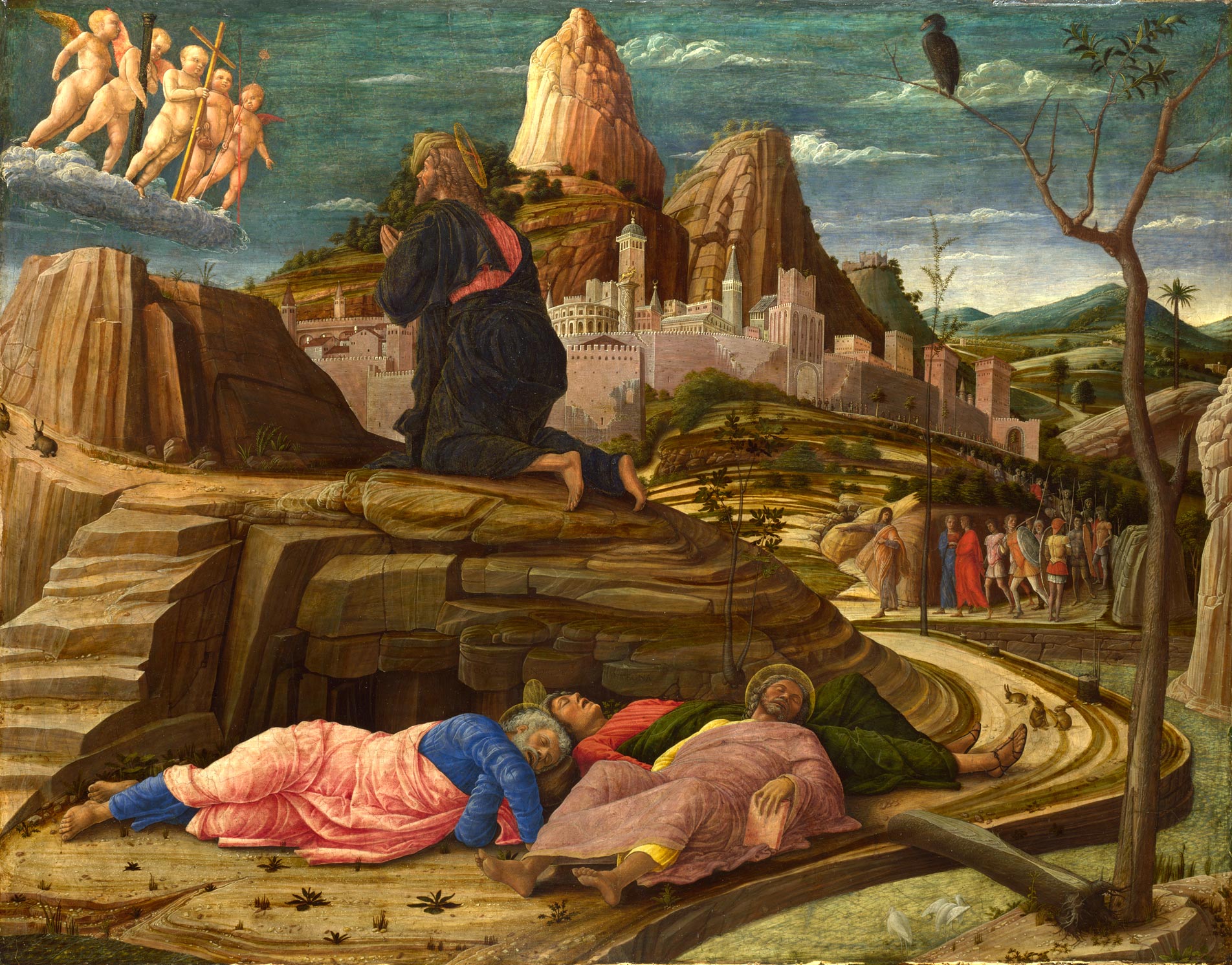
The garden of Gethsemane - where Jesus is believed to have prayed the evening before his crucifixion. Painted by Andrea Mantegna (1431-1506).
There are several sites that are claimed to be the place where Jesus prayed. And Gethsemane is cited in the Bible.

File:Agony in the Garden.jpg


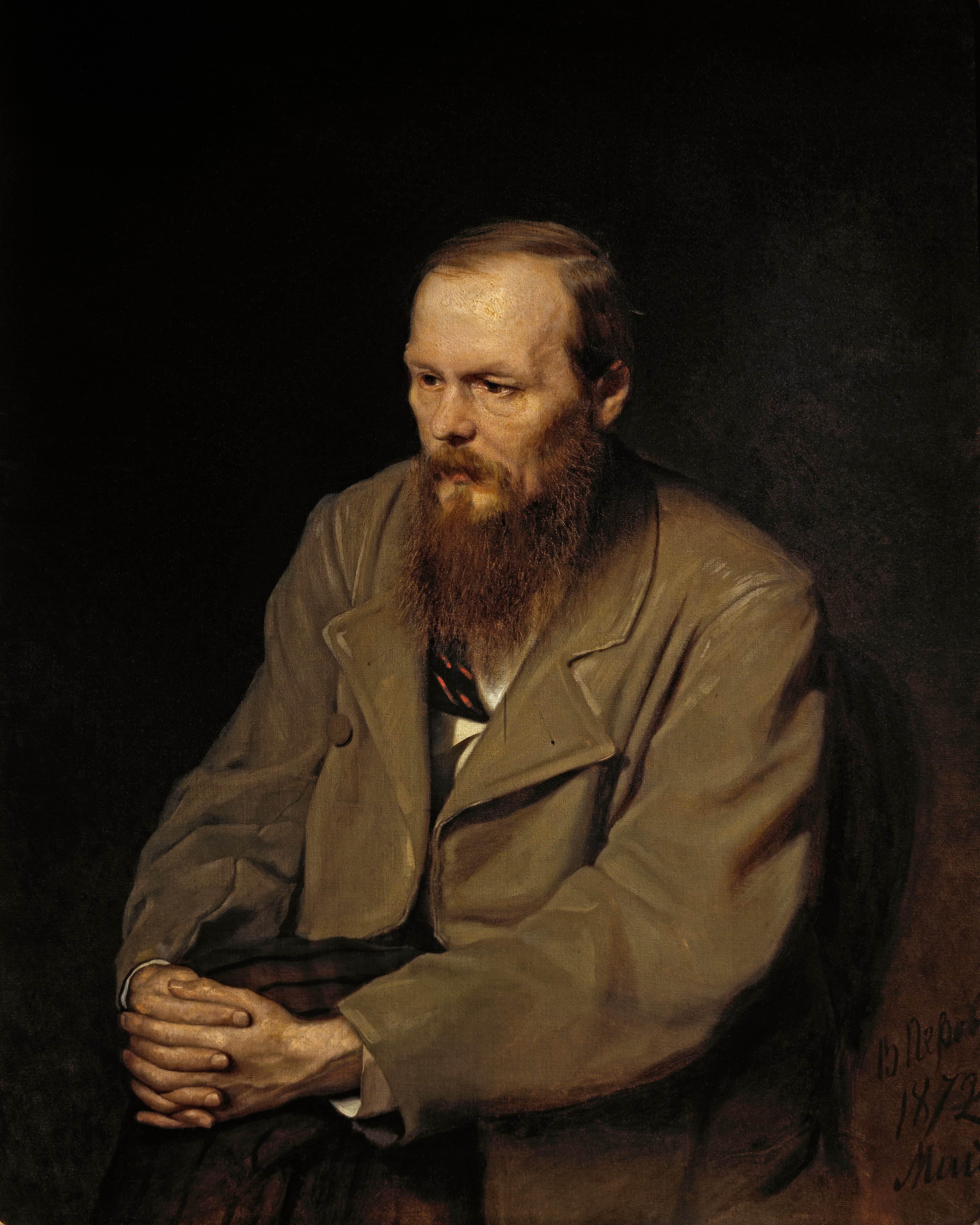
Fyodor Dostoyevsky (1821-1881) painted by Vasily Perov in 1872. His novels, short storied and essays explore human psychology in the troubled political, social and spiritual context of 19th-century Russian society. Acknowledged as a great psychologist he is best known for his works in his later years such as Crime and Punishment, Idiot and The Brothers Karamazov. Demons, mentioned above, "is an extremely political book. It is a testimonial of life in Imperial Russia in the late 19th century.
As the revolutionary democrats begin to rise in Russia, different ideologies begin to collide. Dostoyevsky casts a critical eye on both the left-wing idealists, portraying their ideas and ideological foundation as demonic, and the conservative establishment's ineptitude in dealing with those ideas and their social consequences.
This form of intellectual conservativism tied to the Slavophile movement of Dostoyevsky's day, called Pochvennichestvo, is seen to have continued on into its modern manifestation in individuals like Aleksandr Solzhenitsyn. Dostoyevsky's novels focus on the idea that utopias and positivist ideas, in being utilitarian, were unrealistic and unobtainable.
(Wikipedia)


File:Vasily Perov - Портрет Ф.М.Достоевского - Google Art Project.jpg


How very interesting reading this essay by Albert Camus. I have read parts again and again wanting to be able to make sense of the sentiment. At first I felt a sense of hopelessness from the relentless tasks of life. Doing the same thing over and over again because one has to to live. Is it proclaimed and therefore is? In Sisyphus' case he was set this task by the gods and it seems there was no escaping it and so the task became to find contentment within the situation. And their punishment was the result of his disobedience. He did not follow the principles of the gods, he rebelled.
By this I mean he was functioning on some different level, not a spiritual one.
I relate this to myself. Reflecting on my life, although some things were done to me at a time when I was vulnerable and mould able, in later years I made choices that caused troubles. My behaviour was rebellious, deceitful, destructive and dishonourable. I didn't have this as an intention deep down. I was in conflict with other principles that were loving and caring, truthful and dignified. I had compassion and respect. These two parts were in constant conflict but often the louder voice was the destructive one. Whether that was unleashed through experiences or stronger from the offset, no one will ever know. I tend to think it's a little bit of both. That there is an individual tendency towards heightened sensitivity and when this is coupled with environmental experiences that do not nurture and surround that sensitivity, then there is the potential for another mechanism to be triggered. And often experienced by others as "bad" behaviour.
To exemplify this, I think I am a very sensitive person. I can recall being troubled by many things that I observed. I remember being concerned for one of our neighbours sons, Paul H. I was under 4 when I was concerned. I cannot say why I was concerned for him but something didn't feel right. I was also concerned for K next door. perhaps it was my mothers concerns that I picked up on I really o not know. But I felt a need for them. I was sensitive. And I was also sensitive for myself. When my friends were playing with not such nice kids and stealing from me, I was upset that they could do this and I didn't understand. I didn't understand why people would do mean things.
I was creative with stories but they were stories of loss and disaster afoot. This was from a young age and all through my play stages. The earth cracking up, being taken away and locked up, being treated cruelly by the master. That sort of thing. Was I born with this bleak and black attitude towards life? Or was this created out of being sensitive and surrounded by anger? A bit of both I am certain but putting into words is difficult.
It comes back to the Transactional Model of Arnold Sameroff, nothing occurs in a stand alone position.Everything is interconnected and cannot seemingly be separated.

      
Gosh I am a long way off Camus' essay. So Sisyphus who apparently emerges from a lowly life into the life of the gods, seems to bring with him a degree of rebellion. He is testing the limits which sounds quite childlike. He is given responsibility and living but takes things beyond the principles by which the gods give everything. So then there is the question are those spiritual principles the right ones? Within me yes they feel right but every so often a naughtiness descends that can take me away from following those principles, wanting what seems to be a freedom and a lot of fun. It can be but there is a price to pay. Whereas following more Godly principles seems to bring tranquillity and gently arrives rather than is something strived for and gained.
So Sisyphus is be4lieved to have worked against the gods in different ways but ultimately it seems his disrespect for them earned him the thankless and endless task of rolling the rock to the top of the mountain and then have to start all over again. It's similar to me. I work, I earn some money, I pay bills and then I need to work again to get the money to pay the bills. In between time there doesn't seem to be a lot of pay off. I cannot afford to do the things I desire, as with Sisyphus he has not time for rest and he cannot let go of the rock because his task is to get it to the top of the mountain before it can roll down again.
I do not understand the relevance of his wife throwing his unburied body into the square thus ending up in hell. He tested her love by asking her to do this and she obeyed. Is this not obeying him or should she have disobeyed in the name of decency and respect for his body? To me it is a body and the soul had left already so what matters the body? However, there is something quite important about respecting the vessel for the soul. Honouring it's toil and the job it does. So perhaps she should not have obeyed and instead heeded more the respect for the man she had loved. She had no backbone perhaps to stand by her principles? I'm not sure. If it was this unquestioning obedience that he wanted to return to avenge then I understand. But his desire to return to earth was it to punish his wife? Coming from hell I guess that is what it would do to you. Hell would breed resentment so there is a need to stay out of hell. And the warning is perhaps not to put people to the test, they are bound to be fallible and therefore what I sow I reap. He asked and she obeyed. The consequence was dear and dire.
Yes I can relate that to my life. Principles I crossed, such as terminations of pregnancy and promiscuity and dishonesty and excess of many things like spending and self-centredness and thoughtlessness. These attitudes and the associated behaviours have all resulted in a high price. I pay the price of an increased rift between me and my dad. I pay the price of never being able to make up for the worry that my mum went through and the fact that she couldn't really trust me. I have not been able to settle with any man and I have not achieved in a way I would have liked. I have no family. I have lost reality with honesty. I have been in a heap of a mess. High prices to pay for the many years of fun and hedonism. Fond memories exist but looking at the greater picture would I do it all again? Part of me says yes but the other part says I would go back and learn somehow to do it differently if that were possible. I don't think it's all out of me just yet as there is that urge to say - "bring it on". I would pay the price for some more if I could have it now. And I can but I am also aware of the risk of it getting worse rather than still being fun.
So Sisyphus returns to earth and suddenly likes what earth offers. He hides from the gods until eventually they catch up with him. I was ducking and diving for a while but all the time could feel the hounds nearing until the breakdown occurred when I could feel their breath on my neck and their saliva running down my back. The sound of their pants was in my ears and I cold hear nothing else. I had to surrender or there was certain death. Sometime I welcomed it to get me out of the current futility that I saw.
And being conscious of the futility, fully aware is the thing I grapple with. At times I have total contentment with the way things are. Me and my interactions, the need for work and the things that I can and can't do. But the contentedness comes when I am acceptant and grateful for the things I have got internally and externally. When the futility takes over then the discontent arrives with it.
Of course this myth is an analogy with my life. I am struggling at this time with not only being short of funds for things other than basically covering costs, and at times I can be expensive because of choices. I am also finding it difficult being with L's personality at work. It challenges me sometimes more than at other times. At the moment it is challenging. Now there are day when this can really get me down and I want to run, to do something completely different. These are the days when I am not drawing from the inner gains. The knowledge I can get from this situation day in and day out is extraordinary. But I don't want to hang around and do that. BUT God is making it so that I have to.
I feel jealous of other people who are making moves to achieve. I like it better when there are others in the doldrums just like me right at this time. Sometimes I taken steps into things I'm pleased about and other times I feel stuck. It doesn't expose me as the failure I feel that I am. There's the defect of self-hatred speaking out loudly in that last sentence. This is mental illness. And I truly have it in monumental quantities. Not that mental illness is quantifiable, I don't believe in such a way. It can not easily be said that this person is worse than that person. Often the physical behaviour is what people are judging against. Mental illness shows as unpredictable and sometimes as different from the norm. So I think this breeds fear in others and indeed from within. But once again it can all seem futile suddenly when I see it only at the level of pushing the rock up the mountain only for it to roll down and start all over again with the agony of the journey upwards. Only momentarily getting a sense of achievement and able to enjoy the scenery at the top of the mountain.If, however, I can observe the entire experience, each journey up the mountain brings it's own variety. And if I observe myself in the situation, it's not futile, it's an experience, it's growth, it's strengthening and all contributing towards the next lesson. Nothing then is futile because everything comes from within.
As the Dalai Lama said on Thursday, oh yes I was there in Aldershot when he visited. He said that the Buddha is within, it's not something external. It is my path to reach that internal Buddha and on the occasions when I do I feel grace and serenity. In those moments the external does not matter at all. Acceptance.
Today I am agonising about things that seem unsaid from my sponsor. I get a sense that she strongly objects to therapy. Now this affects me on several levels. It's also interesting as it's upsetting my internal sense of self when actually I feel very comfortable that I know where I am heading. My practice is not only to bring about self actualisation but more importantly about the person finding the way to move forward, and take action for themselves. To move away from dependency on historical voices and messages, to move away from dependency on therapy and individuals and to achieve a sense of self worth and faith.
It seems to matter what she thinks and this morning I have become aware I was being quite underhand or manipulative when I started trying to express what my style of work involves. I wanted her to realise I was good and to be on side against L actually. I realised this and didn't like my manipulation. IN the same way I didn't like the way I manipulated a public arena on Tuesday during supervision to expose L for her exaggeration and deceit. My dad used to be like that. He would make statements to damn me or mum or another person and it would be actually unfounded, merely a manipulation of information or facts to try and control the situation. So with compassion I wonder what it is that leaves her in such need of this. If only she could be comfortable with the fact that she's the boss and no one is questioning that, then she wouldn't need to control the people and they way they are.
However, me me me. I made a comment that I had called B (the person she had said made a statement about people arriving without having the foundations of recovery). The implication was that we were not doing a good job even tough she did add it wasn't directed at us. So my opening statement made it sound as if I had called specifically to enquire about her comment. I said it on purpose as an exposure because B said he was not referring to us. She went quite mad at me, saying that I could have asked her, that she felt let down by me and ended by saying she didn't want to talk about it anymore. Others seemed as confounded as me by her reaction, implying that we cannot be curious and cannot speak to other people. I did later apologise saying that I was sorry that she had felt offended and that it had not been my intention. I clarified that I was speaking with B about another situation and raised the question out of curiosity and made it clear I knew he wasn't referring to us but wondered what he thought needed to be done. She just looked at me. Later apparently S made a comment to her privately about her reaction and L commented back that there is history between us. Well there certainly is.
Now here is my struggle. I felt very down the following day. S and L were working cheerfully together. I felt out of it. I can relate to that with childhood situations, even with my mum and dad being together and feeling as if they were against me. The same happened and is a fear in friendships. Just this morning, M mentioned that S had called her and suddenly I felt left out. My first inclination is to pick up the phone and have a chat as if by chance with S. Crazy. Just sit back observe and trust. I can be at peace within these struggles. At other times I can see only futility as yet another situations presents itself to me as a problem to be overcome. At least my problems are varied. poor Sisyphus had the same struggles and pain day in and day out. I am certain though with each roll of the rock up the hill he must have been physically stronger and wiser, knowing better and better each time how to overcome little difficulties and developing strengths to manage the struggle.
So here I am thinking about that. I know that I can keep my mouth closed and observed. I know it has worked. I know that I could not be so devious, spiteful and manipulative when I use information. I know it is possible to feel OK n myself and confidant that I am doing my best and my best is enough for today. I am learning and growing within myself and how to handle different situations. I am gaining knowledge to help deal with things that can be tricky.
Back to my sponsor. I get a strong sense and from what she's shared to be frank, that therapy is not something she believes in. And so going on a workshop with my therapist seems to have triggered a disappointment or something in her. She feels a little distant and maybe even cross with me. Now I do believe in therapy and for more than simply self-actualisation as she said in the AWOL. It did feel as if it was directed at me. Do I speak with her God? I want to sort it out in a phone call this afternoon. I want to find out if my sense is correct. What do I do God? Now there is a part of me that thinks just sit back and observe. See what happens over the next few days about this. Stay out of my fear and then the ways in which this manifests in codependency. Observe, observe, observe. But at the same time don't try and manipulate. This sense of insecurity drives me to be deceitful and underhand. I don't like it in me. Do I talk to others about this self realisation and find out what others might do?
This is when I'd prefer it that people don't know who my sponsor is. I suppose I could talk about it without using the term sponsor. I could talk about it as a third party whose opinion matters to me and with whom I have a lot of contact.
Hmmmm - please show me God what is the next best thing to do here.

So as I've written this I see more and more what Camus was bringing to my attention


Sunday, 17 June 2012

A class taste

Well what a day! All sorts of experiences to ponder and ask for guidance with ....
I always feel awkward and kind of clumsy when I meet with S. To me she seems so gracious and composed but also I think there is something held back. And then I become all sort of gushing and silly. I feel the child that's for sure when I'm with her and yet I'm old enough to be her mother.
And then whilst in the meeting I felt LARGE. Someone came over during our 5 minute break to remark on how tiny I am now. And E who I had met in my first weeks of being in FA also commented on how tiny I am. I felt the opposite. It's seems odd that I can have such an inaccurate sense of my physical self. When I've been LARGE I feel LARGE but don't see it fully until in a photograph or something. And now I'm slim once again I see LARGE, even in photographs. I was sitting in comparison yesterday.
As my sponsor was saying this morning I have this mental illness and a lot of it for me sits in self-hatred. I compare and despair as B says. And this insecurity and self-hatred means I operate in spiritual blindness. This is important to bring God into this today. God I need help to stay away from comparison with others.
I noticed that with some people I feel uneasy. It manifests in different ways. With N I feel that she is wary of me for some reason. She is almost over friendly and then distant both at the same time. I feel irritated by her for some reason. I' not sure what irritates me though. To stay out of my self-centredness I need to keep in mind her background and what might be going on for her. Of course I can project my ideas of what her issues might be onto her and that can make it worse. I know she had a relapse and returned having gained a lot of weight. When I've been bigger than other people who were once bigger than me I can have real jealousy and even hatred. It's of course hatred for myself really. So I wonder if I'm projecting that onto her. I have felt a difference in her from the friendly person I met. I have stopped calling her and she's stopped calling me. I will call her and say that I've noticed we speak less even though it was regularly anyway.
And with C I see a real defensiveness from her. She looks suspicious. I consider that her childhood in NI must have a real impact on relating with people and life  general. She can't be that old, she doesn't look that old but old enough to have had to live through some very difficult times. Probably even basic survival things. I was please that I was aware of my lack of desire to make contact with her - keep her at a distance because she is distant from me. So I said hello and reminded her who I was because I usually think no one will remember me. We chatted for a while and managed to establish a few things going on for her. She wants to return home and I learnt a little about her job, which she loves. I mentioned to B that I felt jealous of her. And when speaking to H this morning she said she often asks herself what it is she's jealous of in a person as it can be a realisation of things she wants to do. Some of my jealousy is often banal. I'm jealous that B might like C more than me. Or that others seem to like her despite my thinking of her as stand offish and suspicious. That;s when I think it would be important to step aside from my self and learn more about the person. And that's when I can bring to min that perhaps her environment has influenced the way she is. Maybe she's not suspicious at all but that's how it seems. She is very cautious about the people she has contact with. Now she is a little more familiar in the rooms perhaps she will be less threatened by other less frequent visitors. Maybe it's nothing like that at all. I would be interesting in knowing but I think that will take time. Interestingly for me the more someone is withdrawn or distant the more gushing I can be or completely ignore them.
With V i sensed a distance. However, by persevering and talking with her she has been more open. That's not my talking I hasten to add as she stated the other day how detached she realised she can be and is making a concerted effort to engage at a different level. I feel honoured that I am one of the person she has done that with this week.
So all these interactions - it's so fascinating. Then spending time with V. It was delightful that when I spoke with him on the phone and mentioned that I was visiting the Victoria Miro gallery to see the Grayson Perry tapestries, he asked if he could come along too. It was a really lovely afternoon. He is so at ease talking about all sorts of things. He was a little reluctant to talk about his family. He has decided to detach from them. His mother moved to Ghana a long time ago now. He is only in his mid 20's so he has had to fend for himself for a long time. He has no contact with his brothers. I wonder why? I had already felt as if I had pried too much as his entire demeanour altered when talking about these matters. So I backed off despite being intrigued to know more. i have to remind myself I'm not at work and also there is time to be light and breezy. So we were and there was much joviality between us.
I was really amazed at myself having taken us on the number 17 bus to Wharf Road, N1 but it was the N1C  bit that meant we were in the wrong place. Tra la la. We laughed but also I felt guilty and over remorseful. For goodness sake I made a mistake and it was a use of the internet that I didn't bother to check. Who would have thought there could be two Wharf Roads in London N1 even with the subtle difference that I didn't check. V was so gracious talking about the many times he's travelled about and got to a place without knowing where he was and to add to the problem no map either. But here we were generally in the right direction and with the wonder of an iPhone access to Maps app. It meant a little walk through to Angel and then a short bus trip. I enjoy travelling around London by bus, so much more interesting than by tube. Another short walk chatting about all sorts of things and presto! we arrived. Victoria Miro gallery, Wharf Road, Islington, London, N1. What a fantastic premises for a gallery. And Grayson Perry's tapestries were tremendous. Here are some rather poor photos as a taster ....


Unfortunately the photos of the Upper Class tapestries didn't come out clearly, well only two of them are really worth displaying. A real pity.
There are a number of things I'd like to know more about N.E.S.L - what does this stand for? It probably did say in the series. And the anchor appears in some way in each of the tapestries W.R.A.
It became clearer the ways in which the tapestries are influenced by the renaissance paintings as mentioned in the galleries description of the tapestries. As well of course as the inspiration Grayson has apparently taken from William Hogarth's The Rakes Progress. Which I have discovered is at the John Sloane's Museum in Lincoln's Inn Field. I of course now want to go there more urgently than ever. It's been something A and I have been discussing and G too.
Gosh there is so much detail it's difficult to even pin point some of the things I discussed yesterday whilst actually there. Something that was immediate to V was that the Upper Class seemed to be actually transversed with working class. He pointed out everything in the tapestry (and this is the one that I don't have an even half decent photo of) is what he knows to be working class. He said that it could be anywhere in London and then of course reading the scripture of the tapestry it became clear that he was right. The move through the classes is apparently an emulation of Tome Rakeford's journey into wealth, then loss then rebuilding of wealth and finally dying in despair and mental illness. Interesting. The funny thing is that the happiest tapestries were the working class ones. Despite all the buys-ness of them, they were bright and cheerful. The middle class tapestries appeared to be less jolly despite appearance and the upper class tapestries just seem spacious but empty space, not airy. The of course the last one showing hi dead in the gutter despite all his wealth. Gosh a very poignant tale. Is that how it is? Yes I guess for some there is that growth from nothing to enormous wealth and all the trappings but despair with it. The working classes maybe be clamouring for financial security but they are finding pleasure in more simple things. What happens to the thinkers though?
Well it's nearly AWOL time.
A way of life not absent without leave. It's funny really because it's quite the opposite from the absence, it's a real showing up for life. And yet every time I can think of it as absence.
I'm feeling hungry. I'm not sure if this is tiredness. or that I have so many things I need to do and don't want to do them - such as writing a bit more of the accreditation dissertation, tidying and cleaning, reading, walking LouLou. It's probably a complete mix of all of these things.
Oh and I want to call my dad too but have forgotten yet again to talk to anyone about this. I will call someone before I do it.
And then there was the texting with M this morning. I can seem to me that I get it very wrong with M so often. She tells me how she's feeling about things but with little compassion. Or maybe I receive it with little compassion. She is angry that I sent texts and emails asking how she is. She felt that the email was just another way of getting in and as if I'd ignored her text response. It seems to me as if she is confusing me with her mum. Would it be wrong to say such a thing. Well yes for the time being I think it is wrong to say such a thing. Instead I sent a string of words that were from my heart and also my hurt. I will include this text conversation in a separate Blog. Just for interest as it is important in working how to relate with people in the loving and caring way I desire to communicate. People matter to me and I want to convey that value in my actions and not just my words. As I have seen with Grayson Perry and with V and some other people.
I need to continue writing about this as it's important to get down I think.
So bye for now

Bliss
XX


Saturday, 2 June 2012

The Hudsucker Proxy

A Joel Coen film. I can't decide whether it's good or silly. It's in a sort of old 50's style and a comedy but with a very serious undertone. The falsity of the commercial world. I can relate to a lot of it. The loneliness amidst the demands of consistently performing, underhand private agenda's. The power trap and snobbery. The tricksters all wanting to get their cut somehow.
Marketing and commercialism.
It's a a pretty unbalanced world where that kind of attitude is the mode of operandi. And everyone really cannot trust. Everyone has to be on red alert. Everyone wants, wants, wants and at any cost so long as it's not at their own cost.
It's horrid.
A good view of the ways of the supposed civilised communities. Blur!!!!!


Empire says (and gives it a 4 star, I've given it a 3.75 star - out of 5) "Just as Norville Barns lands a dull job in the mailroom of the Hudsucker corporation, the firm's founder is taking a suicide leap from the top floor. In order to take control of the business, the board must force shares to decrease in value rapidly, so they put Norvill in charge"
Tim Robbins plays Barns, Paul Newman is Sidney J. Mussberger, the coniving clever self-centred one. Jennifer Jason Leigh plays Amy the double crossing reporter who falls in love with Norvill.

I guess it was playful and made very good points about the craziness of the world. It was a feelgood film too despite the despair and gloominess. It was like a cartoon version in away of a film I watched where the man was in some purgatory place. Everything was grey, there was nothing that tasted or smelt, the job he was given was monotonous, there was no joy or pleasure in anything at all. What was this film called? It was a foreign film and although a odd I really liked it. It grabbed me more than this one did beforehand. I think it did grab me because it was Coen Brothers film. They make good films and sometimes they make great films!

I'm off to the B's for a walk prior to BBQ'ing
Bliss
X