Tuesday, 12 July 2011

British Sculpture

Henry Moore


Eric Gill
Ecstasy (originally called Fucking)
Mother and child
Joseph Epstein 

Rock Drill

British Medical Building The Strand


Barbara Hepworth


Eduardo Paolozzi (I know - his parents were Italian. OK)


Richard Long


Gilbert and George - everything we do is a living scuplture


Damien Hirst - paintings go on the wall, sculptures go on the floor.


Paul Fryer


Anthony Gormley - the body is the sight of conscousness - in a way of being


Rachel Whitread - the space inside


Anthony Caro - abstraction with the same feelings of humaness. Sculpture is food for the eyes, I don't know what it's for.


Andy Goldsworthy


Elizabeth Frink


Cornelia Parker


Anish Kapoor
There are so many I have been fortunate enough to experience up close and personally.
I love his work

I have really like Henry Moore, Andy Goldsworthy, Eric Gill and Anish Kapoor. Of the others, they are interesting but as yet not grabbed like I am sucked in by the others. There is something I get that is sexy and alive and emotional in those. There are many others I have loved. I really like a Hepworth bust I saw in a gallery but not posted here. So It's been interesting checking out these few

A place worth a visit I reckon!   http://www.sculpture.uk.com/

Bliss
XX

55 Broadway - art deco


Joseph Epstein - Night and Day
David Heathcote said that Epstein had to remove an inch and a half off the poor boy's willy because rain ran down it and formed a perfect arc of water onto the pavement


 Henry Moore - West Wind


55 Broadway is a notable building overlooking St. James's Park in London. It was designed by Charles Holden and built between 1927 and 1929, and in 1931 the building earned him the RIBA London Architecture Medal. It was built as a new headquarters building for the Underground Electric Railways Company of London (UERL), the main forerunner of London Underground.

Monday, 11 July 2011

Just notes on trail of Monet

29 million pounds!
 Wildensteins have denied this painting owned by David Joel is a genuine Monet. The challenge is on.
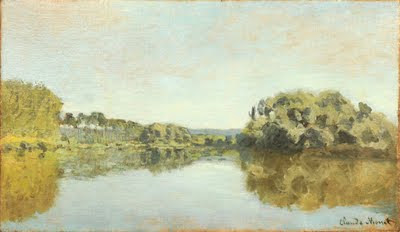


Dr Nicholas Easton
On the back of the painting - reveals more information - stock numbers of dealers and owners.

Prevenance counts for so much!!! Adds to price can you believe???

La Touche canvas - did he supply Monet with canvas'
Monet lived near the location of the painting - Argenteuille

70 years on 2000 canvas'

Impression - Sunrise - where impressionism gets its name Musee Marmottan
Very radical - it was so unfinished. Critics thought it looked incomplete and vague
Le Havre docks - sensual response to it. Just enjoy it with ease

At the Musee there is evidence that La Touche and Monet were friends
An account book from 1872 - written by Monet
Pictures sold to La Touche.

Railway baggage stamp on back of canvas - railway stamp Paris banlieu to Argenteuille - favourite haunt of Monet.
Industrial age

Monet had a boat adapted to paint from

Fiona and David travel along the Seine on a boat to see if they can find the same scene.

Ile Marente

Paris research lab - process of attribution - boundaries being truly pushed
scanning to show unprecedented colour and pixels
View surface and see through layers of paint and reveal the artists technique - like a fingerprint - more so that the signature
Iris Straefer - authority in scientific techniques and Monet- Wildenstein got one wrong!!! She saw that a palette knife had been used which Monet had not used at that time.
A commision was taken away.
She looks at Davids painting ....wow we can see the brush marks - it's amost 3D
She sees typical Monet in the foliage and the sky.
There are almost bits of bare canvas too. She says the painter new what he was doing for sure.
The signature is painted in greenish blueish colour which is typical of Monet who signed in colours typicl of his painting.
She sees the La Touche stamp (made by Gaugin)
Another La Touche stamp also made by Gaugin at a later date. So painting produced befoe design changed.
Evidence starting to stack up -
Is it a Monet - Iris says - YES!!!!! Nothing suggests it's a fake!!

Bloody Hell French customs have kept the painting - Fiona is furious.

7 Days and eventually they get the painting home. Blimey!

connoiseur of Monet - trained eye to identify
From the Courtauld Inst - 3 decades studying Monet
Professor John House - he has never doubted that it is a Monet.
Brush strokes are like a hand writing - and these are very similar to other Monets - a fluency
Other Monet scholars also are convinved its a geuine painting
Why are the Wildensteins saying no then????
They have been unwilling to change their mind - defying internationsl opinion
They have the authority though and hard to over turn that authority

Now they can be challenged!!! Wow

Provenance of this painting -
paper trail - Arthur Tooth - art dealer in London - stock books - number on back of painting match the stock books
Gallerie Georges Petit - with a name Mahoummad Khalil
Georges Petit was a prominent art dealer in Paris.
Kahlil - Egyptian - fascinated by things all French - art buying spree through the Gallerie Georges Petit
When was it in the gallery and when was it brought - this is what the Wildensteins have been asking for
Egypt - Cairo - once the painting was in Cairo
Kahlil spent half the year in Paris and the other half in Cairo
His home is now a state museum - an extraordinary legacy - he lived there from 1915 - 1919
Passionate about French art - and spent vast sums amassing works fromt eh greats
Impressionists - including Claude Monet
Rene Bahir - Museum manager - photos of paintings when Khalil looking to buy them. He was sent photos and found the one we are talking about amongst them
Inof on back of photo the same as on back of painting - the stock number

Checking on the back of all the Khalil collection of those paintings bought from Georges Petit
Same design and colour of ink and stamp - matches the same as out painting.
Hammock is the painting -and a lable saying Collection Georges Petit
Evidence that it was in the collection as the labeetc is all te same
Have been able to prove that it was in the Gallerie before monet died
Its genuine!!!!
Proven!

This should be enoght for the Wildnesteins. David has been trying to prove this for 18 years
I just heard someone at my front door - banging - how scary!!

Presentation to the Wildensteins - John House is coming along as well
A very daunting building
No one gets to meet Guy Wildenstein - they are istructed to leave the painting and the dossier of evidence.
Philip wants to be telling them - but they jst have to wait!!! How frustrating
And they are told to expect a letter within a week
John House is told to return to the Wildenstein Inst at the end of the day.
Interesting????
Damn the camersa can't go in
Guy Wildenstein met John House and a decision was given there and then!!
The result - have they approved the painting???????
Well????
NO!!!!!!! What??? They didn;t take the dossier seriously. What on earth ----
a casual dismissal - not a Monet - don't think it looks right!
Seen by Daniel Wildenstein before he died and Guy won't go against his fathers decision!!

John House cannot respect their judgement.  How fooled the ar world are.
Dynastic art dealing - extremely wealty institution
Need a committee as for Van Gogh etc. People who have earned their status.
This situation is not right
It's deflating

The facts speak for themselves. But with the Wildensteins the facts count for nothing and they also moved the goalposts!!!!
Poor David - passionate man.
They just discounted everything - it's so flipping ffrustrating and I really have foudn David amazing and a wonderful man - he deserves better and recognition.

This is awful

Tough and aggressive business says Philip - and not proud to be part of such blocks on art!!

Another fascinating episode but PAH! To the Wildenstein Institute.

Bliss
XX
Wildenstein, Daniel
Date born: 1917
Place born: Verrières-le-Buisson, France
Date died: 2001
Place died: Paris, France

Impressionist scholar and gallery dealer. Wildenstein was born to a family of art dealers. His grandfather, Nathan Wildenstein, began the business Wildenstein & Cie., in the 1870s selling 18th-century and old master paintings. In the early twentieth century, the business expanded to London and New York where their clients included Henry Clay Frick and J. P. Morgan. The younger Wildenstein was educated at the Sorbonne and spent his early professional years as the exhibitions director of the Musée Jacquemart-Andre, Paris, and the Musée Chaalis in the north of France. He was the publisher of the respected Gazette des Beux-Arts, which he took over from his father, Georges Wildenstein (q.v.). In 1959 Wildenstein took over the gallery business from his father, closing the Paris location in the 1960s and making New York its main office. Always a secretive business, Wildenstein was reputed to have large, unseen holdings of Impressionist masters. In 1978, the "Vault", as the New York storeroom is called, included 20 Renoirs, 25 Courbets, 10 Van Goghs, 10 Cezannes, and 10 Gauguins; 2 Boticellis, 8 Rembrandts, 8 Rubens, 9 El Grecos and 5 Tintorettos among a total inventory of 10,000 paintings. In 1993 a subsidiary of Wildenstein joined forces with Pace Gallery to become PaceWildenstein, a Manhattan gallery specializing in high-end contemporary art. Wildenstein set up a foundation, called the Wildenstein Institute, to issued catalogues raisonnés of major French artists. The Institute issued the definitive catalog on Monet, which Wildenstein personally oversaw. He was also responsible for founding the American Institute of France in New York. The end of Wildenstein’s days, however, were clouded by lawsuits and accusations that his father collaborated with the Nazis during the occupation of France to gain art treasures seized from Jews. The French government dismissed two libel lawsuits by Wildenstein for damages by author Hector Feliciano in his book, The Lost Museum, in 1999. Partially to counteract this, Wildenstein published Marchand d’Art (1999), a series of interviews. In a second case, family members of Alphonse Kahn sought to recover illuminated manuscripts stolen by the Germans and erroneously returned after the war to Wildenstein. At the time of his death, the Wildenstein Institute was embroiled in lawsuits by collectors of Kees van Dongen and Amedeo Modigliani paintings whose works had were being excluded from the forthcoming catalogues raisonnés.
Home Country: France

art passion - Rembrandt

Oh! Wow . I watched another episode of Fake or Fortune. This time Fiona Bruce and Philip Mould have come across a painting for sale in Cape Town. It's marked at auction for £800. They halt the sale as there is suspicion that it is a painting stolen during Nazi wartime art looting from the Van Diemen gallery wned by the Oppenhaimers. Well what a fascinating trail and discovery. Believed to be a Rembrandt gradually the information is whittled down until eventually it is named as a painting by Isaac de Jouderville. He was indeed a student of Rembrandt in 1629. It is known that he travelled with Rembrandt to Amsterdam.
Watching the unfolding of the every detail of information just held me spellbound. I just love the detail and the knowledge of people. The symbols on the back of the painting were as interesting as the painting itself. There was a sticker that appeared very Nazi influenced - wings. But was not the Nazi symbolism. However, there was symbol of fasces - a little bundle of rods containing an ax with the blade projecting, borne before Roman magistrates as an emblem of official power. And this is where the word Fascist was borne. You see how much little detail there is to learn about the world. It's just endless and incredible.

If only I had had as much interest all those years ago when instead I was ensconced in hedonism and escape.
Fiona and Philip have taken me to some most incredible places, people and knowledge. hey took the painting, of course to Amsterdam (oooh pangs for JH) where I was introduced to Ernst van de Wetering. He is considered the world's foremost expert on Rembrandt and his work. Well it was just stunning to watch him and his team. Instantly he saw the painting he knew it was 1600's but he also knew for certain it was not a Rembrandt. He did feel strongly that it was likely to be a student of Rembrandt. Here I learnt more about the studios of the time and the ways in which students copied Rembrandt's paintings. The x-rayed this painting and under the paint it was possible to see the original sketches and previous painting. Philip said that we were seeing the artist making corrections and perfecting towards the end result. Correcting as he went along. Fiona and Philip had already established in the wonderful art archives ( I missed where this is actually held) that the model was used often bt Rembrandt and often portrayed as Rembrandt's father. But apparently he was a studio model.
Oh mys eeeing all the paintings of Rembrandt. I remember being spellbound looking at them. Holding my breath at times, when I was in the Rijkes museum in Amsterdam. What a moment to behold such stunning work.
Back ....
Portrait of Isaac de Jouderville

Studio model often portrayed as Rembrandt's father  AND the same man in the painting we are tracing.

Gradually piecing this all together, the painting suddenly becomes valued at £20,000. Fiona and Philip are finally able to meet the said owner of the painting. He is informed of course of the theft from the Oppenheimer's but that it has also been discoverd that the Opopneheimers had given it to a bank as payment for a loan. However, the bank no longer exists and it is then believed that the Nazi's had plundered the art of the bank. The documentary episode explained how Goring had stored so much valuable art for himself. As did Hitler. Goring in fact had ordered that the stolen art was divided between himself and Hitler. Poland, Russia, as well as, the Jewish collections were all plundered. Approximately 20% of the art in Europe was looted by the Nazis, and there are well over 100,000 items that have not been returned to their rightful owners. The majority of what is still missing includes everyday objects such as china, crystal or silver.
Tragically much work was destroyed too. The Third Reich decalred modern art degenerate art and it was order to be destroyed. Alarming!!!!
(I wonder if it was, maybe a soldier here and there kept something for themselves and it's been passed down the families - as with this painting. It was Herr somethings grandfather's and Herr whatshisname had inherited from his mothers estate. Fiona was bold enought to ask if his grandfather had been a Nazi to which he said no!!) Now of course Herr oojiflipp was in a situation when Fiona on TV asked if he was prepared fotr the painting to be returned to it's rightful owner if that person or organisation could be traced. He had to say yes. Of course I am sure that was all rehearsed before hand. The programme is a BBC drama documentary after all.
Well I have just been thrilled by the education and another complete absorption into the world of art. I love it.

The Oppenheimer family is a study all in istelf ......
Oppenheimer / Oppenheim Families
Descendants of Samuel Wolf Oppenheimer

The Oppenheim(er) family was a very old family with branches throughout Europe. Some family members achieved great fame and fortune.

Heidelberg was a University town in the grand duchy of Baden, Germany. Although Jews were recorded as living in Heildeberg in 1253, The elector Rupert II. expelled all Jews in 1390. But From the middle of the fifteenth century onward Jews were regularly received in Heidelberg under comparatively favorable conditions. There was a very small Jewish in Heidelberg. In the middle of the seventeenth century (1600's) , 5 members of the famous Oppenheimer family were living there. In 1704 thirteen Jewish families were living at Heidelberg, Some members of the Oppenheimer Family moved to Frankfurt am Main and Vienna and became extremely wealthy Court Jews and Bankers.

The Oppenheimer / Oppenheim Families are descended from Samuel Wolf OPPENHEIMER also known as Samuel Heidelberg.

Samuel was born in Heidelberg., so he was from, one of the very few Jewish families who lived in Heidelberg.

He moved to Vienna, and became a Court Jew to Emperor Leopold and Banker , imperial court factor, He enjoyed the especial favor of Emperor Leopold., to whom he advanced considerable sums of money for the Turkish war. When Austria was embarrassed by its depleted exchequer on the outbreak of the War of the Spanish Succession, in 1701, Samuel Oppenheimer and his two sons, together with the most important commercial houses of Germany, took charge of the commissariat of the imperial forces in Lombardy, the Upper Rhenish states, Tyrol, Bavaria, and Hungary. After his death in May 1703, the imperial government put his estate into bankruptcy, plunging all the stock exchanges with which Oppenheimer had been connected into a serious crisis, especially the Frankfurt stock exchange and all its brokers.

Another descendant of this family was the famous Joseph Süss Oppenheimer (1690-1738) who held the office of court factor to Prince Karl Alexander von Württemberg in Stuttgart. His mother was also a Frankfurt resident, and Jud Süss Oppenheimer often spent months in Frankfurt, where he owned a commodious house outside the Judengasse. Lion Feuchtwanger based the historical novel "Jud Süss" on Oppenheimer.

Professor J. Robert Oppenheimer, the inventor of the Atomic Bomb was also a descendant of this family

Samuel Oppenheimer.is the 17th Great Grandson of Rashi related through his Grand Mother Frummet BALLIN to Yocheved Bas SHLOMO Rashi's Daughter

Marc Heymann is the 9th Great Grandson of Samuel Oppenheimer.

Another member of this Heidelberg family Reb Joseph Oppenheimer from Heidelberg is Marc Heymann's 4th Great Grandfather.

He was the 7th Great Grandson of Rabbi Judah Loew the Maharal of Prague and the 3rd Great Grandson of the Chavas Yair Rabbi Chayim Yair Bacharach.

Sunday, 10 July 2011

What to call it?

what does it mean?

Responsible in the media

"We envision the time when the Media has become fully aware of its power and the part it plays in the collective consciousness; a time when all those who carry the enormous responsibility of projecting words and pictures into the homes and minds of millions of souls do so with integrity and respect for this great duty of care which they carry;..."

I suspect that there are some within the world of the media that are very responsible and consider the points they are making. There are occasions when watching a documentary, I am concerned at the one-sidedness. I am left with questions, especially wondering what the full picture is and points of view from other angles.
Same with the papers. I am so skeptical, I just don't know what to believe. A little bit of truth in everything. There are times when something seems to come from some deeper place. A sense of genuine belief. I think it is possible to tell - but then it is still a particular perspective even if it comes from a passionate view.

I pray for growing integrity for myself and for others

Bliss
xx

I love Pooh philosophy

"Rivers know this: There is no hurry. We shall get there some day." -Winnie the Pooh :)


Posted by my friend L who just has always loved Pooh.
I really enjoyed reading the Tao of Pooh. I want to read the Te of Piglet.
Very very clever.


Here's some things I already collected


The Tao of Pooh
Winnie the Pooh has a certain way about him, a way of doing things which has made him the world's most beloved bear. And Pooh's Way, as Benjamin Hoff brilliantly demonstrates, seems strangely close to the ancient Chinese principles of Taoism. The 'Tao of Pooh' explains Taoism by Winnie the Pooh and explains Winnie the Pooh by Taoism. It makes you understand what A.A. Milne probably meant when he said he didn't write the Pooh-books for children in the first place.


Over the centuries Taoism classic teachings were developed and divided into philosophical, monastic, and folk religious forms. All of these could be included under the general heading of Taoism. But the basic Taoism is simply a particular way of appreciating, learning from, and working with whatever happens in everyday life. From the Taoist point of view, the natural result of this harmonious way of living is happiness.


One of the basic principles of Taoism is P'U, the Uncarved Block. The essence of the Uncarved Block is that things in their original simplicity contain their own natural power, power that is easily spoiled and lost when that simplicity is changed. This principle applies not only to things, but to people as well. Or Bears. Which brings us to Pooh, the very Epitome of the Uncarved Block. When you discard arrogance, complexity, and a few, other things that get in the way, sooner or later you will discover that simple, childlike, and mysterious secret known to those of the Uncarved Block: Life is Fun. Along with that comes the ability to do things spontaneously and have them work, odd as that may appear to others at times. As Piglet put it in 'Winnie-the-Pooh', "Pooh hasn't much Brain, but he never comes to any harm. He does silly things and they turn out right."


Owl instead, is the opposite of Pooh, the Knowledge for the sake of Appearing Wise, the one who studies Knowledge for the sake of Knowledge, and who keeps what he learns to himself or to his own small group, rather than working for the enlightenment of others. That way, the scholars can appear Superior, and will not likely be suspected of Not Knowing Something. After all, from the scholarly point of view, it's practically a crime not to know everything. But sometimes the knowledge of the scholar is a bit hard to understand because it doesn't seem to match up with our own experience of things. Isn't the knowledge that comes from experience more valuable than the knowledge that doesn't?


While Owl's little routine is that of Knowledge for the sake of Appearing Wise, Eeyore's is that of Knowledge for the sake of Complaining About Something and Rabbit's is that of Knowledge of Being Clever. As anyone who doesn't have it can see, the Eeyore Attitude gets in the way of things like wisdom and happiness, and pretty much prevents any sort of real Accomplishment in life. Cleverness, after all, has its limitations. Its mechanical judgements and clever remarks tend to prove inaccurate with passing time, because it doesn't look very deeply into things to begin with. The thing that makes someone truly different -unique, in fact- is something that Cleverness cannot really understand.


"A fish can't whistle and neither can I." There's nothing wrong with not being able to whistle, especially if you're a fish. But there can be lots of things wrong with blindly trying to do what you aren't designed for. Unfortunately, some people aren't so wise, and end up causing big trouble for themselves and others. The wise know their limitations; the foolish do not. To demonstrate what we mean, we can think of no one better than Tigger, who doesn't know his limitations ('Tiggers' can do everything'), which brings him in lots of trouble. Piglet instead knows his limitations and that's what makes him sometimes more brave than you would expect from such a small animal. So, the first thing we need to do is recognize and trust our own Inner Nature, and not lose sight of it. Inside the Bouncy Tigger is the Rescuer who knows the Way, and in each of us is something Special, and that we need to keep:


"Tigger is all right really," said Piglet lazily.
"Of course he is," said Christopher Robin.
"Everybody is really," said Pooh. "That's what I think," said Pooh.
"But I don't suppose I'm right," he said.
"Of course you are," said Christopher Robin.

Isn't this just something special?? I love. I would like to get hold of the books again at some point. And eve a copy of the original Pooh and read it as a child reads it.

Bliss
XX