Beings naturally experience pleasure; but when pleasure is contaminated with craving, not releasing it creates frustration and tedious suffering follows.
Dhammapada v.341
Ajahn Munindo says ...
With the right quality of mindfulness at the right moment, we can see why and how attaching to joy and sorrow perpetuates suffering. We become interested in how to experience pleasure without making it 'my' pleasure or creating an 'I' that is having a good time. Wise reflection shows us that when attachment is taken out of the experience, happiness isn't diminished - in fact it is enhanced. When we are accurately aware, intelligence can function in the service of insight. If we appreciate how grasping at the pleasure spoils the beauty, an ease of being emerges.
Mmmm interesting. Of course loaded with my own issue of addiction, which involves craving, this disease so far cannot be 'cured' and therefore the wisdom is to not 'pick up'. However when it comes to food and relationships the cure is about having boundaries and this is where I can get a little confused. If it is possible to have boundaries and therefore engage with the behaviour that is supposedly addictive, why isn't it possible to have boundaries around substances etc??? It is a question that really I am not looking for an answer to yet it does get raised often enough to make me wonder. The thing is I suppose that the craving is for an instant gratification to avoid dealing with something at a deeper level.
Then there is sexual gratification. This is the most powerful 'reward' known to man. It's no wonder people get addicted to it. I think it is a more powerful addiction for men than for women. Some women I hear a total sex addiction. For me I truly believe that the sex element is more about being in a relationship or gratifying a man. However I have experienced the joy of sex and it has become intense for me within the relationship or liaisons (for example slavery).
So I think when I have re-read the above statement by Ajahn Munindo I am gaining this understanding - I am not sure how to put it into words. Craving is an indication that I am believing that something external to me is the cause of happiness or pleasure. And what is far healthier is when I realise that actually it I that have experienced happiness and pleasure within me. If I remove the externals I can still experience happiness and pleasure just through being and if I engage with that happiness and pleasure. The longing or feeling of being without seems to bring pain and loss and actually that is within me. Again I can be with that loss and pain but remove the feeling of suffering because of loss.
Mmm not sure I have made sense of things there. I can be a light and happy person without the need of anything at all. This emotion is within me and accessible at any time I choose. I can choose to be happy. When the clinical depression isn't on me I can easily do that. I can acknowledge when I am suffering and re-think that quite easily. I would never deny myself my emotions though. And often I think the Dhammapada is talking about not having the full range of feelings. But actually I think it is the opposite. The spiritual growth is to take a look at the feelings and what is behind them. Suffering the Buddhists say is a necessary part of the journey towards healing and well being. Just as psychologists say that any change has varying degrees of grief - denial, anger, sadness, bargaining and then acceptance. Depending of the attachment levels the journey through those five will be variable. Often when reaching acceptance it goes again. It's a process, not to be stopped but to be observed and permit.
That's what I think. I do read it though as if the way I do it is wrong and feelings are not permitted - That is loaded with messages from the past. I think religions and belief systems are so misunderstood. Actually I know it's a legacy of history - interpretations and re-interpretations BUT I think the Victorian era had a lot to do with puritanical living. There was a very exacting attitude. Perfectionism. And then two world wars after which a sense of "should be grateful" as people had survived such hardship. It's interesting to step back and see how social events and situations impact upon beliefs and cultures.
And of course with the world wars it was about science - more and more equipment to outsmart the enemy. I expect people had to ignore the effects on people because it was so enormous. Although there was research intot he effects of war such as PTSD. I wonder why there was so little assistance then for sufferers. I always think the army can't really acknowledge problems otherwaise they would become compasssionate and lose the aggression to teach men to be fighters and killers. I do think the army selects angry young men. Men who do not know they are so angry. The are ripe for the job. Dysfunctional backgrounds gerasped and turned into fighting machines. Obviously Natonal Service meant that men were swept along wven though thery weren't naturally aggressive - and of course the desire to defend the country.
"19th-century society (1840-1900). Late 19th-century society inevitably influenced the outlooks of many early psychologists. In an era dominated in the UK by Queen Victoria, it is perhaps not surprising that nineteenth century society is seen as strict and regimented, with little opportunity either for women or for individuality. However, it was also an era of inventions – from the telegraph in the 1840s through to the motor car, telephone, and great advances in engineering, in travel and in the natural sciences. It was also in this period that modern psychology came into being in a number of countries. As an era, it was one in which it was believed that everything could be classified, ordered and tamed, through science, engineering and medicine. Perhaps not surprisingly, measurement and classification were two important themes in the work of early psychologists, alongside the development of medical psychiatry and early studies of hypnotism and hysteria. The development of psychology in the late 19th Century is also important because there were no funded University posts in psychology until the end of the century. As such, early psychological research was (with some notable exceptions) generally conducted by 'gentlemen scientists' who tended to come from privileged backgrounds"
"World War I (1914 - 1918). Psychology was first used widely in the First World War in 1917, when mass psychometric testing was carried out by the US Army. Psychologists also studied 'shell shock' or war neuroses (later recognised as Post Traumatic Stress Disorder or PTSD)
It could be argued that applied psychology was effectively born during World War I. For instance, studies of fatigue in munitions factories were the first major industrial psychology studies to be conducted. Psychologists also worked on specific programs, like for instance, the selection of hydrophone operators best suited for 'hearing submarines'. According to Hearnshaw (The Shaping of Modern Psychology, 1989), the work of psychologists during World War I “helped to establish the claims of applied psychology, and led to its continuation on a still small, but nevertheless significant, scale” (p. 200). "
"World War II (1939-1945). The Second World War had two main effects on the development of psychology. Firstly, a diaspora of Jewish intellectuals from Europe arrived in Great Britain and the United States, and secondly, psychological research was funded, and used extensively during the war.\n\n1. The diaspora. The diaspora refers to the scattering of Jewish people around the world before, during and following the Second World War. This scattering of intellectuals had a pronounced effect, not because of the psychologists who fled, but also because of the many US or UK psychologists who came into contact with many new ideas for the first time. This included not only fellow psychologists, but also philosophers, linguists and novelists.
As well as the Jewish diaspora, a large number of gentile intellectuals also left Germany and mainland Europe before and during the war, often for New York or London, where they interacted and greatly influenced the existing scholars. According to Peter Robinson, who edited a volume of essays dedicated to Henri Tajfel “…it is thanks to the émigrés of Henri's generation that the field gained a foothold in the academic world” (Robinson, 1996, p. xi). 2. Applications of psychology. Unlike the First World War, when the application of psychology began only towards the end, psychology was used almost immediately from the beginning of World War II. Also, unlike World War I, where most psychological input was in the selection of recruits or treatment of 'shell shock', during World War II psychologists contributed in a variety of different areas. For instance, psychologists worked on:
• Personality psychometrics – Psychologists devised tests used for the selection of 'officer material' and in the main combatant forces. In the UK, the War Office Selection Boards were set up in 1942 for this purpose, and by 1945 some 100,000 applicants for officer rank had been psychometrically tested. Also, during the war factor analytic techniques first applied on a mass scale – for instance, H.J. Eysenck studied 700 patients at the Mill Hill Emergency Hospital during the war. This research was the basis for his subsequent theory of personality.
• Psychiatric disabilities of war – For instance, work at the Tavistock Clinic on Post Traumatic Stress Disorder and Psychoanalytic theories.
• Attitude research - large research programs on attitude change and persuasion were funded by the American Army during the war. Related research on leadership and group behaviour was also extensively funded during this period.
• Interaction with equipment – World War II was unique in its reliance on human operation of new technology, in areas as diverse as air traffic control, radar or code breaking. This led to psychological research into topics such as vigilance, training, stress and decision making. During this time, some old concepts (e.g. attention) were investigated with new vigour, while new concepts (e.g. stress) were developed as explanatory concepts.
• The rapid development of neuropsychology in the 1950s was very much based on studies of combat victim's head wounds and their subsequent psychological functioning"
This is information from OU - just a snippet from the Timeline that I find very helpful. So yes everything was very rigid and tidy. Scientifically, what was going on within the person i.e. emotions and thoughts were considered irrelevant. So just do away with it altogether. Not practical. And I think this has a lot to do with the ways in which stresses manifest so mentally these days. Illnesses that are draining because emotions such as anger and sadness are not permissible. It's all about gratifiation and feelng good all the time. Feeeling good is a part of a process but more and more society offeres ways to instantly feel good. Then what happens with the yin of yang the black and the white the positive and the negative. All of thes things are what makes a being wholesome. Without working throught the black the negative the yin then the positive, the white, the yang is less fulfilling.
Well that's my thoughts on it anyway.
Drop the instant gratification and work through what is actually gong on and then truly feel fulfilling gratitude.
If only I could practice this all of the time
Right off to London - if the B's are actually fit and ready.
Bliss
XX


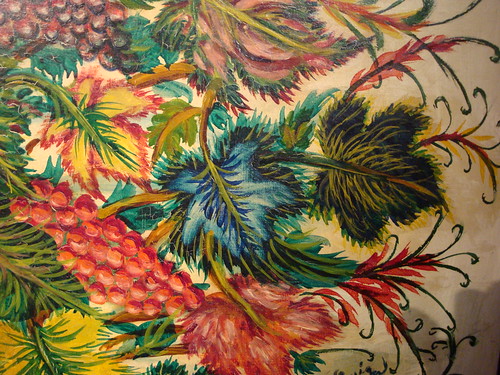

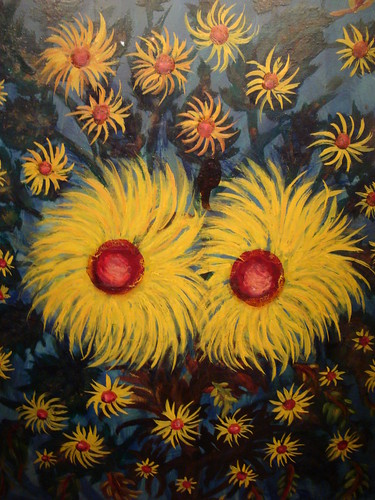

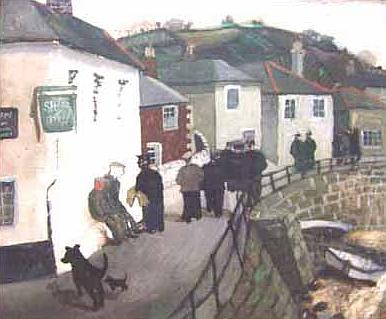
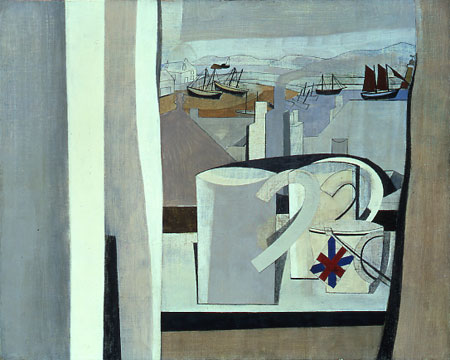
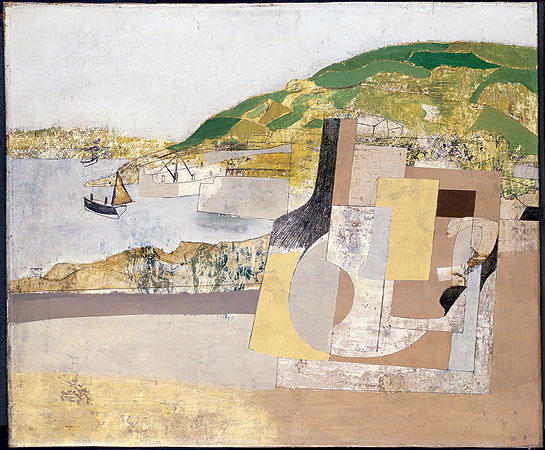
 Everything is so light. I learnt that his final studio was in fact bright white light. A stark whiteness.
  I was thrilled by the description of this piece by Barbara. According to the art historian Dr James Fox, Barbara was accused of being abstract. But she said she had captured the bay of St. Ives. The shape has been curled around. The white represents the beach and the lines are the waves as they roll in. I think it's stunning. I want it of course. At least I would like to see it at some time.
 Inspired by the standing stones in the area and to be found all over Devon and Cornwall. She remained in St. Ive and sadly died in a fire at her studio. Previously, she had been creating larger and larger sculptures. Her work was in demand. An unusual achievement really for a female to succeed as a sculptress. Considering her delicate look, there she was chipping away in a very demanding art form. She had assistants actually but if anyone visited they had to hide away.

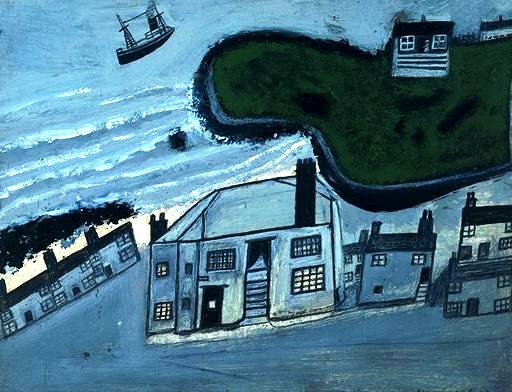 The very tiny house is apparently meant to be his brothers house. They had fallen out so he took out his anger through his painting. How funny!


 So delicate. The shapes he said were inspired by everything around him in St. Ives - shells, rocks, coves, the sea ad so on.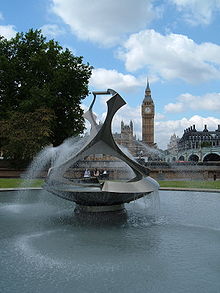
 At the end of the war he left for New York.

 I didn't like these quite as much.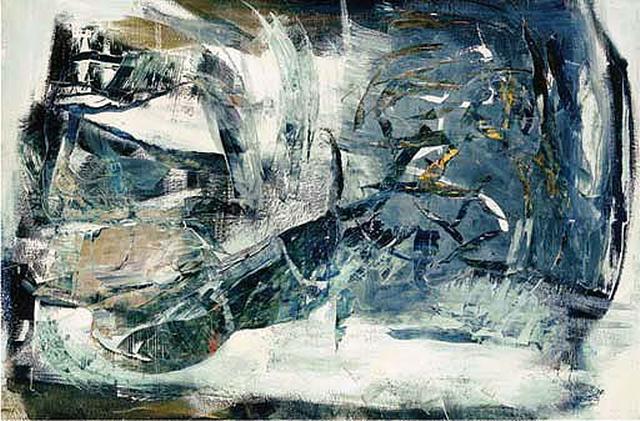


 He also took great pleasure in putting colours on colours. He found the painting of the last bit of white where a new colour met another precious on painted exhilarating

